About this Blogsphere:

This blogsphere attempts to capture, catalog and share resources relating to visual perception of information. It is about a world mostly dealing with Physical (Touch, Taste, See/Sight, Smell and Hear) and sometimes Metaphysical (and that is none-of-the-above category). Physical, for instance, touch (e.g., feel, felt, found), look and visualization, is here with an attempt to combine verbal, vocal and visual--to synchronously see, hear, share and do much more. Interestingly, in order to visualize one does not need special skills, competencies, etc. It is all about common sense, especially with human visualizations. In short, "information is in the eye of the beholder." Continue reading much more all-ado-about this Blogosphere

Akbani is a Cutchi Memon family name.

Showing posts with label Infrastructure. Show all posts

February 03, 2007

Sight, Sound, Senses Visualized - Creative Innovations in Touch and Tell Spheres

[NB. Rest in the Waiting: smell, taste, touch]
  • Web site helps name that tune in your head [Sify.com]
    Singapore: You know that annoying tune that you can't place or get out of your head? A US company has recently launched a Web site, www.midomi.com, that names most tunes that you can hum, sing or whistle a tune into your computer microphone. [Image source and more details: Website Lets Users Search For Unknown Tunes That Get Stuck In Their Head, Thursday February 1, 2007]

  • Librarians will see Margaret Atwood's Long Pen for the first time at the Ontario Library Association Super Conference's THE 2007 EXPOSITION, Feb 1 -2, 2007

  • Margaret Atwood's telepresence book-signing robot Clive Thompson, March 01, 2006
    Wow: Margaret Atwood has become the first author to sign books in remote locations -- via a telepresence robot!


    Last fall, she hooked up with a Toronto company called Unotchit (which sounds roughly like "you no touch it") that developed a device that works like this: Unotchit sets up its robot in a remote bookstore. Atwood logs in from home, and using a webcam, talks to people who are attending the far-off book-signing. She chats with 'em, asks what they want inscribed on their book, and they lay it in front of the Unotchit robot. Atwood writes on a screen, and the robot replicates her pen-strokes precisely, in real-time, on the book.

    Previous posts in the same row and isle:
  • Guided Imagery / Visualization - Uses with the Cancer Patron
  • Infomedia Revolution Revisited
  • Visual Communication Vistas Revisited
  • Scientists and Artists: Who should design learning?
  • The Technique of Song and Sound Visualization
  • December 09, 2006

    A visual Newsmap

    From News clips, and News in Photos (all static and consuming), and then News in Pictures, and to a far more interactive, dynamic, Web-based streaming and information visualization, is a long trip. But that trip is now over.

    Visual Newsmap has all in one click, and its your click
    concept

    Newsmap is an application that visually reflects the constantly changing landscape of the Google News news aggregator. A treemap visualization algorithm helps display the enormous amount of information gathered by the aggregator. Treemaps are traditionally space-constrained visualizations of information. Newsmap's objective takes that goal a step further and provides a tool to divide information into quickly recognizable bands which, when presented together, reveal underlying patterns in news reporting across cultures and within news segments in constant change around the globe. Continue reading or LAUNCH

    November 20, 2006

    Visual Search Plus

    New E-Commerce Search Engine Ditches the Text, November 10, 2006 7:55AM

    Like.com uses face recognition technology; it looks inside a photo and creates a digital signature that describes the photo's content and enables a more accurate search for similar looking items.


    Now you can search images... i.e., information visualzation re-vitalized by a Web 2.0's team of Indian Guru: Munjal Shah @ Like.com [PS. riya -- Arabic word for hypocrisy, or ostentation or show-off in a egoistic sense; the following is not that riya, rather this is all-ado-about best practices]

    What others say:
    "AI is also being used at Riya to find photos by matching on characteristics - density, patterns, colours" says Gwen

    "Like.com is from the creators of Riya.com,which in short, is a photo sharing storage system with some smart AI(artificail intelligence). You dump in a thousand plus images in, tag a few, and riya starts to recognize images of people, puts them in groups, and automatically tags them over time. Riya recognizes colors, images, text, faces, and much more. The more people that do this and share their images, the better. Imagine seeing all those pictures of yourself from other peoples cameras during those holiday vacations you walked into!" continue reading @ designverb


    More in the news:
  • Star Search: Shopping Site Uses Visuals ECommerce-Guide, United States - 15 Nov 2006
  • Click it & Ship it Window shop celebrity styles on Like.com Lowell Sun, MA - 14 Nov 2006
  • Google vs. Guruji.com - A Desi Perspective on Search Engines Desicritics.org, India - 12 Nov 2006

    My previous post:
  • visualization - ebscohost’s cool new integration of grokker
  • information visualization at eurekster, a swicki search engine
  • wheels for google, google on wheels
  • surf maps: visualising web browsing
  • dontclick.it - web usability visualized
  • Searching Is Polarized; Will The Five Laws Get a New Revised Version: Every Search Engine Its Searcher

    Technocrati Tags:
    Visual search
    riya.com
    like.com
    index images
    searching_images
  • October 23, 2006

    Visualization - EBSCOhost’s cool new integration of Grokker

    This is an old news. Ya.
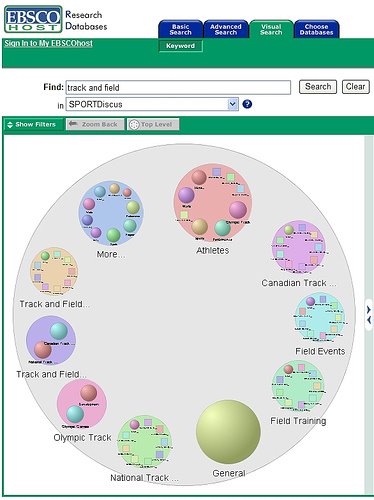
    But, a new perspective. I felt I had done my 2 cent's worth by including Grokker's feature in Web search visualization. But, now I find Grokker is with EBSCO and moreover, incorporated in the library search menu (precisely for searching in EBSCOhost’s databases), as described below:

    Visualization. This is what actually inspired this series of posts. I went to a demo recently of EBSCOhost’s cool new integration of Grokker (which my library supposedly has a trial subscription to, but it isn’t working right now). Grokker allows a multidimensional visual representation of search results, which includes clustering. If you’re not familiar with the concept, check out Grokker’s website. The whole thing is difficult to explain but incredibly simple to use. I wish Ebsco had adopted this 4 years ago; grad school would’ve been a whole lot easier.

    The beauty of this type of visualization is manifold: It allows the user to see relationships. It allows the user to more easily refine searches based on immediate visual processing of results, and with other included tools like a time slider. It doesn’t require users to scan through page descriptions, which often are poorly written and not representative (less of a problem outside of the web). Most importantly, IT ISN’T UGLY, so users are more likely to use it. During the last usability study of my library’s website, users uniformly avoided using the “search this site” box because the results it returned were ugly and confusing, which is pretty difficult to avoid with text-based results. (I can’t even imagine the confusion they would’ve encountered had I tested them on our digital projects search engine; hopefullly we’ll be testing that later this year.) This is no way to treat users! continue reading @ digitize everything on searching Sweet Jesus, I hate (most) search interfaces! (part 2)


  • Visual Searching (in Flikr and EBSCO: above image), Posted by gsennema
  • Visualize This, By Judy Luther, Maureen Kelly, & Donald Beagle -- 3/1/2005, Library Journal [look for visualization, visualizers, visualizing tools, and corporate support for visual search]

    And the following news, re-read:
  • Groxis and EBSCO Publishing Partner to Provide Visual Search Technology
    Grokker Visual Search Now Available via EBSCOhost®

    My Webliography on Visual Catalogs:
  • Innovative Practices to Connect Every Book, Its Reader
  • Mining The Library Catalog
    My previous posts:
  • Information visualization, 23 Dec 2005 by Mohamed Taher
    For Yahoo search results via Grokker
  • Information Visualization Demystified, 16 Mar 2006 by Mohamed Taher
  • Visualizing the Innernet or Visual Display of the Website's ... 13 Jun 2006 by Mohamed Taher
  • August 16, 2006

    Surf Maps: Visualising Web Browsing

    An Atlas of Cyberspaces - Surf Maps:
    Visualising Web Browsing


    An atlas of maps and graphic representations of the geographies of the new electronic territories of the Internet, WWW and other emerging Cyberspaces."


    Contents include:
    | Introduction | Whats New | Conceptual | Artistic | Geographic | Cables & Satellites | Traceroutes | Census | Topology | Info Maps | Info Landscapes | Info Spaces | ISP Maps | Weather Maps | Wireless | Web Site Maps | Surf Maps | MUDs & Virtual Worlds | Historical |
    See also:
  • Squint-free web-browsing, at Teblog, David Tebbutt on cooperation, collaboration and communication
  • “visual search” @ Pixsy Corporation


    Technocrati Tags: Surfing
    Visualizing

    Googling for more sites

  • August 07, 2006

    DontClick.it - Web Usability Visualized

    dontclick.it - Institute for Interactive Research


    "Navigate the Web in a different way..." Thanks The Addled Librarian for this link.

    Here's a bit more info on the site:
    The site's technology also allows the developers to keep statistics that will inform them about how many users can actually resist clicking while visiting the site.
    "We do not only record the site visits. With every visit the first click that happened will be recorded as well. The relationship between these two numbers tells us, whether people can resist to click within this interface, or, if they just click the next thing that looks like a button because they are determined by their clicking habits."
    Check it out, and see how long you can resist the temptation not to click. Thanks to Capulet Communications for this visualization


    See also:

  • Usability In The News: DONTCLICK.IT: What a clever idea. A never click your mouse interface. But what happens when you are trying to select an item out of a list? ...
  • Dontclick.it: Demonstrating an alternative web user interface ... Alex Frank's dontclick.it site demonstrates a mouseless user interface. The site requires Flash (you'll quickly see why this is so).
    I got the hang of the "clickless" navigation straight away. But, boy, does it feel weird. Alex's design demonstrates that some aspects of HCI interaction have become very, very deeply embedded ...

  • NB: This is not Mouseless Browsing It is all about navigating with a click-free concept.

    August 04, 2006

    Market Visualization Software - Its for free

    What's making news now:

    Free OS Visualization software from Microsoft Virtual PC 2004 and ...
    The OS Virtualization software Microsoft and WMware now giving away one of its virtualization ... The WMware is the market leader for OS Visualization. ... Plus more both download software is old version. but worth for try it out if you ... continue reading

    See also: my previous post
  • information visualization and its applications, + a growing base in all areas of life, business, etc.
  • God.com: Web Analytics Series no.2
  • Beliefnet.com: Web Analytics Series no.1
  • Market Research Resources via Libraries
  • Business of Blogging Report 2006
  • First Impressions Last - Webmetrics visualized


    Technocrati tags:
    Blogs: Market Visualization

  • July 29, 2006

    Wheels for Google, Google on Wheels

    Here, visualization of Google is neither about physical wheels nor about googling for a four wheel drive.
    No way.
    Google is going fullspeed and needs no wheels, as yet. This post is not even about the Google's Wheel of Fortune!!! And, it also not about what is in another blog: Google: Won't Re-Invent the Wheel or the Browser
    In short, it is none of the above.


    What is below is another spin of the wheel--Spinning in alpha-numeric terms.

    By the way. Wheel has its own ax (or axe) and like all the holy words, wheel has secular, spiritual, magical and mystical dimensions. First the transcendental nexus:
    "Chakra in Hindu means "wheel." In Buddhist, Jainist, and Hindu beliefs, Chakras are vital energy centers in the body. continue reading"


    And, now the alpha-numeric, with a slant towards digital inspiration:
    Information visualization of Google using the wheel gives extra energy to this virtual domain.

    See the following two samples:
    Google Number Wheel by Philipp Lenssen, July 28, 2006


    Google Alphabets Wheel: English Alphabets in Google Search Results by Amit Agarwal on 7/29/2006

    Inspired heavily by Google Number Wheel that's a brainchild of Philipp Lenssen, here's a different version of Google Wheel for English Alphabets.

    It is easy to read the graph. Each pie segment on the circle denotes the number of Google search results for a particular alphabet. For instance, Google Web search returned 24 billion documents containing the alphabet "a" while just 1.7 billion results for alphabet "q".


    From my own blogs:
  • Web Analytics - A Librarian's Outlook
  • Web analytics @ Multifaith Information Gateway
  • July 16, 2006

    Visualizing Traffic At My Blog Via Mapping The Pathways

    A running post, last updated Feb 3, 2007.

    This is a sequel to my previous post: Visualizing Comments on Blogs

    I am given to understand that 'high blog traffic flows in' if we are writing about Bill Gates, Deepak Chopra, Pat Robertson, (or "Even something inane and mundane gets to be a hit at times"). Read more on this minsdet in my above mentioned blog post

    Today, I found another site that instructs on this very subject, but in a different way:

    Blogs need SEO too, by Neil Patel, July 05, 2006

    Here are the most common mistakes that I see on blogs:

    1. Most blogs do not have meta description tags. You can find a plugin for your blogging platform that will easily add it to each post. You can setup the meta description tag to automatically pull the first sentence from your blog post.

    2. The URL strings on many blogs are dynamic instead of static. You do not want extraneous characters in your blog.
    http://www.pronetadvertising.com/looking%20forward?to@!the231lit.html
    You want clean URLs like this
    http://www.pronetadvertising.com/articles/looking-forward-to-the-little-man.html

    3. Most blogs state their name in the title tag and then the title of the post.
    PaulStamatiou.com - Search Engine Optimization 101
    The two should be reversed.
    Search Engine Optimization 101 - PaulStamatiou.com. Continue reading from Blogs need SEO too


    Measure Map Feeds - and a new Widget
    Looking for better representation sources, I found this write up on widget. And, I signed up for Google's venture: Measure Map. But, I don't have access to it, as of now. I believe it helps in visualizing the blog traffic, graphically. If you know of any similar tool (other than Google Analytics) please let me know.

    See also:
  • blog-a-nomics, Gale Martin
  • 16 Ways to Drive Traffic to Your Blog
  • Google: traffic, blog
  • Technocrati Tags: blog traffic
  • del.icio.us Tags: blog traffic
  • Weblogology: The Study of Blogs
  • More on Weblog theory

    Punch Line:
    Two views about the repeat visitors
    Repeat visitors are not a good measurement either - I used to visit Toronto.com a lot, but only because they were really the only game in town. Did I like their site? Not really ... but I kept coming back out of necessity. Continue reading: AJAX Feedback Mechanism

    I looked at your traffic stats. What do they tell you? How do you interpret the fact that you get almost NO repeat visitors? Study some A List, high traffic blogs in your field or just in general. What are they doing that you might consider doing? Continue reading

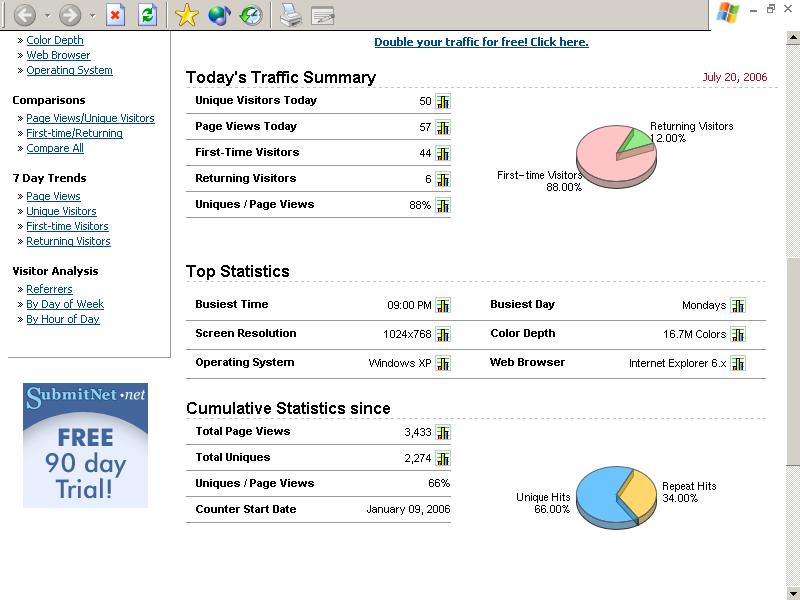
    With malice towards none: My repeat visitors in one day (i.e., today) is 12%; and since birth of this blog, repeat visits are 34% on the whole.

    Now, do you have any comments on the above two observations and this real-time picture of my blog's traffic, as seen below:


    See my previous posts:
  • Blog As A Teaching Tool
  • May 21, 2006

    Scientists and Artists: Who should design learning?

    An interesting perspective, indeed!!! The above title is from an article posted by Gsiemens, at the Connectivism Blog.
    [P.S. Incidentally, I tried to leave my comment on the same page, but the blog requires registration. Hence, I post my comments here. I hope this will benefit all those who have not crossed this creative visualization]
    Thank you gsiemens for the balanced approach in presenting the debate. Also thanks to Deirdre Bonnycastle for highlighting the (intrinsic and extrinsic) value of information visualization. Here, I reproduce the comment by Deirdre Bonnycastle
    Here's a question to ponder "Why are most educational Blogs full of words?" "What is it about the alphabet that consumes educational practice?"

    While it is proverbial to say a picture is worth a thousand words, I would quote the original author (to show the true colors): “Words and pictures can work together to communicate more powerfully than either alone.” This quote by William Albert Allard, interestingly, also supports the reason for the existence of my blog, viz., Information Visualization.
    Back to the article and its debate - who is more competent. My comments are as follows:
    On the question who should design learning, my own answer will be (agreeing with the author), none of the above. I am a librarian, and understanding the process of educating the educators was my Fulbright project (more specifically, it was to get a feel of how user education program was implemented in American libraries, 1989-1990). I have taught library science for over fifteen years -- all without any formal training in the area of how-to-teach! Only recently I took a course (Teaching effectiveness Certificate), to get a look and feel of educational methodology. (Wherein, two courses are taught by a Nursing specialist).

    Permit me to narrate my experience. I did a presentation in the above course. My presentation had three goals, viz., a) introducing the class to blogsphere, b) facilitating visualization of how blogs can be both entertaining and educative and c) present the results of my research on trends in blogging and blog as tool for the educators. View this research survey results at my blog: Blog As A Teaching Tool. At the end of the lecture, as a stimulant, I presented the Blogga song [See details of this on my blog: The Technique of Song and Sound Visualization]. Blogga song is by and for librarians, but entertains everyone.
    What I learnt from this presentation is that the participants were motivated to a great extent by this lecture and the tools that I brought in. A few were familiar with the name blog, fewer had seen it, and finally I initiated them to be bloggers, at the end of day.
    What I infer, from all the exposure and experience is, competencies and skills if shared collectively, and if digested professionally by any one, can result in producing good design and aid in good delivery.
    Recall cases where teachers with master or doctoral degree in education have failed and failed badly in communicating actual sense of learning objectives (L/O) & / Or learning outcome (lot). The debate on the importance of such fundamental concepts continues even in this 21st century.
    My belief is good teachers are not made; they are born.
    Interestingly, the Connectivism Blog -with its subtitle: Theory of how individuals and organizations learn in a digital ecology- has much more content, context and concerns for us as teachers.

    May 17, 2006

    Every Book Its Reader - Ranganathan's Law Visualized

    Here is a book. It borrows its title from Dr. S R Ranganathan's third (of the Five) Laws of Library Science. The details of the book are:
    Nicholas Basbanes. Every Book Its Reader: The Power of the Printed Word to Stir the World (HarperCollins, 2005). Reviews
    What makes the book interesting for me as a librarian and a student of history?
    Simply stated, it is my curiosity to find out how relevant is my Guru's Five Laws of Library Science and how his mantra is still floating in a world that is now flat (as per the history of the world by Thomas Friedman).
    OK. What are these Five Laws? To read click here
    Going by the title one may ask:

    • Is this book about outsourcing?
    • Is this book about extranets
    • Is this book about offshoring
    • Is this book about open-sourcing?
    • Is this book about In-forming

    Incidentally, such questions are bound to be asked, if one has just finished reading, India versus Indiana: Who is Exploiting Whom? - a chapter from The World Is Flat: A Brief History of the Twenty-first Century by Thomas L. Friedman, Farrar, Straus and Giroux, 2005. see my comments on Friedman's book
    A single answer to the above questions would be, simply said, the book has none of the above.
    A last question one may have, because as a student of Library Science, I succinctly recall that there is one significnat implication of this third law. This implication is all-a-do-about OUTREACH. That is, reach everyone of those who cannot reach the library.
    Then, does this book deal with libary services and innovations in outreach and reaching out?
    The answer, again, is in negative.
    WHEREAS, the book is about how the printed word--or how the love of books--makes history (i.e.,Yesterday, Today, and Tomorrow of the printed books). As a student of library history, I see this book is of great value for the posterity.
    On the Law, per se, I have a word to mention.
    The author writes an interesting note about Ranganathan and his Five Laws:
    In time he wrote fifty monographs in his field, most notably Five Laws of Library Science (1931), which outlined a set of principles that ha become a guiding code among professinals.

    Three of these laws--Books Are For Use, A Reader's Time is Precious, and Libraries are Growing Organisms--were directed primarily at his colleagues. The other two--Every Reader His Book and Every Book Its Reader---have meaning for anyone with an abiding respect for the written word. They also form the guiding premise, and suggested the title, for this book.(p. 15-16)

    Furthermore, regarding the appropriateness of the Third Law for this type of library history (meta book, book about books, and bibliomania), I had my own doubts. And this doubt is clarified, to me, by a close assoicate of Dr. Ranganathan, viz., Prof. A Neelameghan, in the following words:
    In general, the set of Five Laws constitute the guiding principles / the fundamentals of library and information service in the changing info environment. LIS professionals would do well to provide service that complies with these laws.
    End-users (readers) may also use the first three laws to ‘evaluate’ the service they are getting from the library, again in the changing info environment. (personal communication, dated May 16, 2006)

    ‘Every Reader His/Her Book’ can, as I mentioned earlier, viewed from the library professionals point of view and also that of the ‘Reader’. A reader may search first an online catalogue / union catalogue (in a library or from home), then (or straight away) go to the library for his book, or to a book shop, and to a friend’s book collection, etc. depending on when his need gets satisfied. When he visits the library the latter is expected to have organized the collection, etc and provide services that ensure the reader gets his book from its own collection, or through inter-library loan, or reader given advice where and how else he / she may get his / her need satisfied; sometime it may be another book that satisfies his / her need better than the one he / she may be looking for. The interpretation of the Laws can comprehend different viewpoints. (further clarified in a second personal communication, dated 17 May 2006).

    The Bottom Line: Thank you Nick (ie., Prof. Nicholas Basbanes) for this learning opportunity. And Wish You Good Luck to Write More Books. But, do not forget the mantra. I mean, remember there are four more LAWS of my Guru. I wish and pray that God give you a long life to write at least four more books.

    May 16, 2006

    Google Trend - Another Way to Visualize the Blogosphere

    Click here: blogosphere, and you will see the true colors of search results.

    In short, Google has another source of information visualization, viz., Google Trend. You can view graphs and news articles relating to whatever you search and wish to compare search results.
    About Google Trends
    With Google Trends, you can compare the world's interest in your favorite topics. Enter up to five topics and see how often they've been searched for on Google over time. Google Trends also displays how frequently your topics have appeared in Google News stories, and which geographic regions have searched for them most often.

    Examples. yankees, red sox · skiing, surfing · summer camps · earthquake · tax forms, tax extension · hurricane katrina, gas prices ...
    Read all the FAQs

    May 09, 2006

    Blog As A Teaching Tool

    This will be a running post: Updated 2 March 2007


    Blogging for Scholars
    Does your prof blog? If he or she does, you had better know about it. Professors who blog do so for a variety of reasons. Some are musing aloud over new ideas or research that will later appear in scholarly journals and on your library's shelves, virtual or physical. Some are exploring new ways of expression or appealing to a larger audience than they get in the paid lecture hall. Or they may be trying out a side of themselves that they don't quite dare expose fact-to-face with their primary community Continue reading @ Emerald LibraryLink

  • Moving Student Blogging Beyond the Classroom: Another Look, Posted by gsiemens, August 09, 2006
  • Emerging Teaching Tools. Distance Learning, Screen Recording, and Blogging, Ruth Duffy, July 24, 2006
    The theme of this conference -- Unfolding the Future -- is focused on ways to enhance tomorrow's college and workplace environment. In our workshop, we have highlighted three of the emerging technologies -- Blackboard, Camtasia, and Weblogs -- and how they are being used at Shoreline Community College. Now we would like to hear from you...
    If you are uncertain about how to do any of these steps, click here to go back and review. You may also listen by choosing "play this audio post" below. continue reading

  • Amanda @ blogwithoutalibrary.net, cites a new publication: "teaching social software," July 18, 2006, and Amanda states:
    Heads up: if you have any interest at all in teaching social software, you should read Teaching Social Software with Social Software by Ulises Mejias in the current issue of Innovate: Journal of Online Education (free registration required for full-text)...
    As you can imagine, I was thrilled to stumble upon this article (thanks, Paul!), given the fact that I’ll be doing a bit of teaching-social-software-with-social-software myself this Fall. I was even more thrilled to find out that Innovate hosts webcasts with their authors, and Mejias’ webcast happens to be this Thursday at 12pm.

    A Biological Blogger, July 14th, 2006
    Paul Z. Myers, an associate professor of science and math at the University of Minnesota at Morris, is something of an accidental blogger: He only started after setting up a Web site for students enrolled in one of his courses...

    How does a blog on developmental biology become such a big hit? Injecting a bit of politics into the proceedings doesn’t hurt: Mr. Myers, who bills himself on the blog as a “godless liberal,” mixes strongly worded attacks on creationism and intelligent design in with other “random biological ejaculations.” —Brock Read . Continue reading from A Biological Blogger. More of this Genre Webblogged at Blog Juice for Educational Technology

    Not sure, what is this all about?
    Hearing, seeing and listening may change your perception.
    Here you go [just-in-case you want to be oriented towards this subject] with a :

    TITLE: How and In Which Situations Web Logs or Blogs Work: How and Why They are Valuable in Children's Education
    SPEAKER: David Weinberger
    EVENT DATE: 11/15/2004
    RUNNING TIME: 55 minutes. (Thanks to Web Capture @ Library of Congress for sharing this excellent speech)

    I guess I am the ten zillionth person who is trying to visualize the above question. The deep web has this question and stated in umpteen ways. Nevertheless, the most common concerns include, viz.: a) the suitability of this tool to communicate; b) the compatibility of this tool in interactive learning process; and c) find WHAT WORKS, WHAT DOESN'T, WHAT'S PROMISING

    Let us begin with a reflection on the process involved and visualize the whole picture:


    "...These days it is rare to talk about a single function tool. Many discussion board providers now bill themselves as community software providers and bundle other tools into their products such as chat, instant messaging, polls, blogs, wikis, member directories and file sharing. So you will find some overlap between the first few sections of the tour and the groupware section! In addition, there is sometimes a split in communities where some like blogs and wikis and others prefer discussion boards. This split may be generational, but regardless of its origin, it is helpful to be aware of this and figure out how to bridge between the groups when picking tools."[source: Web Based Discussion Tools, in Tool Tour, by Nancy White. See also herein excellent illustrations and examples in "Social Software Tools (Blogs, Wiki's, and Other Creatures)."


    I will summarize my findings. The Webliography at the end of this article will give a link to some significant resources.

    A. Blogsavvy's prescription very valuable (value added because, it has received 53 comments, which would mean some thing that is really worth looking at!)

    How NOT to use blogs in education:
  • Never never approach blogs as discussion boards, listservs or learning management systems
  • Group blogs are a bad idea and don’t work
  • Don’t try and force blogging into something else
  • Ignore RSS at your peril

  • B. Arguments for and against using Blog are equally educating, in the Blog by Anthony Moretti, and I quote:
    Arguments for using Blog as a Tool:
  • Young people are using this technology; they might not read as much as we would like them to, but they do blog (and love pods)!!
  • Can foster creativity and expression; if this gets students to write, think, analyze; why not use it?
  • Cheap; can be set up for no money and be used in a variety of ways
  • Errors, omissions, biases, etc. can be caught
    Arguments against using Blog as a Tool:
  • Small audiences
  • Staying power?
  • Deciphering the junk from the credible

  • C. Despite the above inspiration, the Sixty Four Dollar question remains:
  • Are blogs good for education? Bill Bruck wrote in his blog as early as in December 2004 in Blended Learning:
    Well, they aren't awful. They are fashionable right now, and so may gain learner acceptance. They get learners to write, which is inherently good, and to express their opinions - which may or may not be a good thing. But there's a fundamental problem with blogs: They are essentially optimized for easily publishing one’s opinions on the web. This is fundamentally a flawed model for education. It promotes narcissism, not dialog.

    D. And the wise continue the debate. The latest evidence-based wisdom comes in a podcast, "Blogs in education: podcast," delivered by Keith Burnett’s blog, and posted on April 2nd, 2006
    Educational uses of blogs include: as class diary for a specific group of students, as notice-board for a whole cohort, and even as a space for students to write themselves.
    Students producing their own blogs requires careful thought. Web pages are cached by search engines and can be held in ‘frozen’ form for years – for this reason students might want to post under an assumed name. You also need to check College regulations about external publication by students. Some students find having their own page to show off work a motivational factor. Some teachers use blogs as notice boards for whole cohorts of students. I would suggest switching off the commenting in this case and possibly adding an e-mail list facility so students can have new notices e-mailed to their inbox.
    I find that I have most success with blogs used as class diaries – each class has a page. I can pop a summary of each lesson on the blog, and I can add links to Web pages with exercises, explanations, interactive quizzes or demonstrations. The blog can then be used by students who were at the lesson as a reminder of the main themes (and homework) and as a guide to carefully chosen and relevant Web pages. Students who had to miss all or part of the lesson can find a summary, possibly with text-book readings and some links that will enable the student to get the gist of the lesson and be able to join in a little more next week.

    E. Research Prospects in this Area
  • Blogs help students think for themselves,by Anna Salleh, ABC Science Online, 2 September 2005:
    Blogging is helping students to think and write more critically, says an Australian researcher, and can help draw out people who would otherwise not engage in debate.
    These are the preliminary findings of PhD research by Anne Bartlett-Bragg, a lecturer at the University of Technology, Sydney, who has been using weblogs or blogs in her own teaching since 2001.
    She says blogs are also extremely useful for categorising and managing a large collection of thoughts, whether they are from lecture notes, a student's own ideas, or comments on the ideas of others.

    F. Webliography:
  • Susan Crawford. Blogging on blogging on blogging, 02 Jun 2006
  • Zarah Grace C. Gagatiga. Blogs as Teaching Tools, 1 May 2006 
  • --. Blogging as a Tool for Teaching, March 29, 2006
  • Anthony Moretti. Using Blogs as a Teaching Device, 2 May 2006
  • Minjuan Wang, and Laura Bock, The Use of Blogs in Teaching, Knowledge Management, and Performance Improvement, World Conference on E-Learning in Corporate, Government, Healthcare, and Higher Education (ELEARN) 2005
    Vancouver, Canada October 24, 2005, ELEARN, Volume 2005, Issue 1.
  • Craig W. Smith. Synchronous Discussion in Online Courses: A Pedagogical Strategy for Taming the Chat Beast
  • Teacher dude. blogging and teaching ESF/EF, 3 May 2006
  • GIL KLEIN. iPods, podcasts latest teaching tool in classrooms, May 1, 2006
  • Ben Yates. Wikipedia as a teaching tool, 19 Jul 2005 
  • Learning from blogs, by Anna Davis, at EduBlog Insight [EduBlog is a place to reflect, discuss, and explore possibilities for the use of weblogs in education]
  • A. S. Tolba. The Potential of Blog as a Teaching and Learning Tool, 4 Nov 2005
  • Bryan [ http://killthefattedcalf.blogspot.com/2006/02/academic-blogs.html dead link ], Academic Blogs
  • Ewan McIntosh.Assessment is for Learning - so is blogging
  • What are the pitfalls of using blog as a teaching environment?
  • See also Blogsphere Search results 1 and Blogsphere Search results 2
  • Natasha Spring and William Briggs, Ed.D.The Impact of Blogging: Real or Imagined? [text in pdf]
    Microsoft's technical evangelist Robert Scoble met recently with CW Executive Editor Natasha Spring and frequent CW contributor William Briggs to set the record straight on blogs, their impact on the media, whether companies have anything to fear from this new communication medium, and the release of his new book, Naked Conversations.
  • Dorai’s LearnLog. Effective Bloggers are Learners, Thinkers, Explorers and Dreamers, May 26, 2006
  • Nancy White. Seven Competencies of Online Interaction,from the Northern Voice 2006 Canadian Blogger Conference in Vancouver on 11 February 2006
  • Diane Levin ,Mapping the blogosphere yields information about human behavior for social scientists, June 27, 2006
  • Track A — Blogs, Wikis, and Collaboration Tools, Internet Librarian International 2005, Transcending Boundaries: Information Technologies & Strategies for the 21st Century, 10-11 October 2005 • Copthorne Tara Hotel, London
  • Improving the quality of online presence through interactivity, Information and Management archive, Volume 42 , Issue 1 (December 2004), 217 - 226: 2004
    Online interactivity is becoming a valuable way of improving the communication quality of business web sites. As a result, it is important that web site designers understand the concept and how it affects the quality of web site design. This study empirically validated Ha and James' five interactivity dimensions (playfulness, connectedness, reciprocal communication, information collection, and choice) and their relationship to design quality. Continue Reading Improving the quality
  • Goodbye, Blog: The friend of information but the enemy of thought, by Alan Jacobs
    Whatever one thinks about the structure of the internet as a whole, it is becoming increasingly clear that the particular architecture of the blogosphere is the chief impediment to its becoming a place where new ideas can be deployed, tested, and developed. Take, for instance, the problem of comments. Continue reading Goodbye
  • TLT Group. Exploration Guide: Educational Uses of Blogs, Wikis, RSS Feeds, etc.
  • Using technology in teaching and learning cited by Cindee. [Full citation ]
    Using technology in teaching and learning: Resources to help you navigate a digital world, C&RL News, February 2007, Vol. 68, No. 2, by Bryan Alexander
  • Accuracy and the Blogosphere
  • Wikis, blogs and podcasts: a new generation of Web-based tools for virtual collaborative clinical practice and education, by Maged N Kamel Boulos, Inocencio Maramba, and Steve Wheeler, BMC Med Educ. 2006; 6: 41.
    Published online 2006 August 15. doi: 10.1186/1472-6920-6-41. [full text]


    See also my previous posts:
  • Citing a Blog, Wiki - Style for bibliographic notes and references
  • What's a blog - WYSIWYG
  • Blogging Spree: Trends in Information Visualization
  • Information Visualization at Wikipedia - Blogspheres Perspectives

    Quotable quote from Library Stuff:
    The power, posted December 19, 2003
    Anna writes:
    "There's something seriously wrong with the world when one innovative, blogging, rarin' librarian can have more links in a web directory than one of the most important theorists on classification and indexing."

    That's the power of weblogs, especially in the library world. I'm not sure why this is surprising, however. Who is more likely to have more content on the web, Jessamyn or Ranganathan? You will probably find more information on Ranganathan in books (library science 101, etc), than Jessamyn. Also, as Greg so dutifully points out, most of the links are interviews. When was the last interview you read on Ranganathan?
  • May 01, 2006

    Isolatr Vis-a-Vis a Unified Theory of Web 2.0

    This will be a running post: Updated 19 Oct, 2006


    The term "Web 2.0" (pronounced "web two point Oh") was conceived in 2005 to describe a new breed of websites that use newer web authoring tools, are low learning curves (for the user) and support a collaborative environment ... usually free and usually just all done in a web browser. source: Web Two Point Oh


    Here, I wish to talk about a nascent Web-based movement called anti-social network (ASN) - i.e., the isolatr(s) who are in a crowded mall. The domain name, www.isolatr.com, was registered in March 2006, but the movement is getting stonger by day and is also supported by technocratis, business people, and the like. This is one side of our story. The other side, synchoronously active and up, is about pro-social and pro-technical development in sustaining the infrastructure and infostructure of the Web. It is about a proposed theory of strengthening the network by Ajit Jaokar and those associated with the Internet backbone. The question is: Whose practice & / or theory is consolidating the network (s)? And, which sort of network(s) will last longer? To hear these stories you will have to bear with the narration of a librarian-cum-techie.

    In the beginning there was the Word, and the Word was with God, called 'isolate.'
    Oxford English Dictionary, says: i·so·late
    • v. cause (a person or place) to be or remain alone or apart from others: a country that is isolated from the rest of the world.

    And, then, God wanted to be Known. Or, as some others would put it, know yourself.
    So ended isolation, I suppose? And this movement continued till I was alerted to diagnose my blogging spree.
    A creative minority among the Netizens wish to give me a break. And the story of their move, going with introverts, is making waves. Lets' begin with my acquaintance with the word: isolate.

    As a student of library and information science, I was taught of common isolates.***

    As a student of Multifaith world, I learnt about Solitude (also seclusion, isolation). An interesting quote is here: "May you discover solitude in a crowd." A blessing by: Swami Veda Bharati.
    Now, comes from the blues, yet another isolatr:
    "Link my blog! Link my blog. This shit is like gang rape sometimes. With Isolatr I can finally tell all these schmucks to get bent." source: Isolatr--the Anti-social Network

    Thanks to Jen for the tip about the Isolatr.

    And thanks to Tate for thinking loudly about a middle path, to any one who is looking around:
    Is it possible to want to be in Isolatr and Linked-In at the same time? I want the best of both worlds. Give me access to people wanting to help or learn without being bombarded by people demanding to sell or preach.

    My Sixty Four Dollar opinion and question: I don't like the analogy of 'gang rape' for a professional activity that is loved by all: also known as, citations, reference and linking. Dr. S R. Ranganathan's Third Law of Library Science says, Every book its reader (read as, every information its user). By this law of dissemination, asking other bloggers to index my blog is not akin to any kind of begging, let alone exhibitionism or leading to temptations of getting raped.
    Moreover, a request to say "link my blog" is something which the faithful cherish to do forever. Because it directly fulfills the Divine plan of being known - collectively and individually. In short, to be known you have to know, and cannot remain in isolation or in a self-contatined well.

    However, I like the creative visualization of the minds behind the Isolatr Web site.
    And, you will agree: see a sample from the FAQs:
    .Q: Can I invite you be [...] at this random web related conference I'm organizing?
    .A: No.
    .Q: Can I invite some of my friends to join me on isolatr?
    .A: NO.

    Anyways, this ASN phenomenon is catching up speed -- may grow or not, is not the question. The question is based on two other premises: First, the Web has gone deep into our daily life; second, Web has reduced the distances of both time and space. Based on this two factors, can we even think of going back into self-imposed (or randomly selected) categories of solitary confinement??? Will we be willing to loose the competitive intelligence (as well as the business intelligence) skills and competencies that we have built and brought so far?
    And, what is this about the Web in our daily life? This may amaze some. And, those may like to read my review of the following book: The Internet in Everyday Life, by Barry Wellman (Editor), Caroline Haythornthwaite (Editor)

    I think the Internet (despite it being both a bane and boon) with the forces of convergence that the technology today facilitates is likely to last longer.
    And, all this visualization of a stong, connected and networked social capital is not in isolation - nor my own juxtaposition against the practices of the Isolatr.
    See the other side of the coin: A unified theory of Web 2.0 loaded with a conceptual (social, technical, and infrastructural) framework is at A Unified Theory of Web 2.0
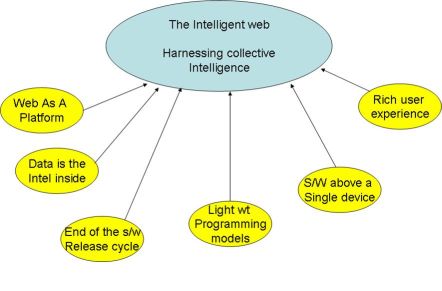
    I like this mind-map and would love to share with my audience:

    Ajit Jaokar, a member of the Web 2.0 Workgroup has made an attempt to formulate a unified theory of Web2.0 based on re-arranging the seven principles layed outlined by O’Reilly:

    .The Web As Platform
    .Harnessing Collective Intelligence
    .Data is the Next Intel Inside
    .End of the Software Release Cycle
    .Lightweight Programming Models
    .Software Above the Level of a Single Device
    .Rich User Experiences

    What about Ajit’s wrap up then?
    .What is web 2.0? It’s the intelligent web.
    .What makes it intelligent? We do.
    .How does it happen? By harnessing collective intelligence
    .What do you need to harness collective intelligence? The other six principles!

    May the breed of thinking reative minds for social networking grow fourfold - Amen.
    For those who wish to re-view the above theoretical perspectives, might get food-for-thought from Netanel Jacobsson's questions

    ***[That is, some isolates can be like minded, to be called common and unlike others. F.Y.I. This is the knowledge that matters in classification of documents, and defined by Dr. S R Ranganathan, in his Colon Classification. Ranganathan, a genius, had many isolates, including space, time, etc., that would go along with his pack of the Five fundamental categories in a book classification process, viz., Personality, Matter, Energy, Space, and Time]


    March 05, 2006

    The Technique of Song and Sound Visualization

    We have many such ode visualizers. Don't believe?
    Listen and watch at Brian Smith, the Laughing Librarian's Blogga song. Copyright 2006 Brian Smith.
    ~~~~See also: Slashdot Song
    ~~~~Google for more song visualization in the blogsphere and sound visualization.
    Thank you lalcorn in Library Stuff for getting me to this world of Blogga song.

    Techies may like to get a feel from the following: Simulating Acoustic Fields. See also their case studies
    Disclaimer: This blogsphere aims to disseminate information with malice towards none.

    February 21, 2006

    Information Visualization at Eurekster, a Swicki search engine

    I am happy to have found a dynamic visual search engine:
    Eurekster, a Swicki search engine. Click and view a sample: Information Visualization blogsphere.

    Courtesy: Bringing You A "Library 2.0" Perspective, by Michael Casey

    I quote from Michael's LibraryCrunch:
    What’s a swicki? According to Eurekster, a swicki is a search engine that takes results from a relevant community – your community – and in the process improves the relevancy of results. Along the way it also creates a tag cloud (they call it a “dynamic buzzcloud”) that reflects recent searches. Here's how Eurekster describes it:
    Joining the personal Web publishing phenomenon on blogs, podcasts, wikis and websites is the swicki - a next-generation search engine that gives personal and small-business Web publishers the power to design and deliver results tailored to their community's specific interests. A blend between a search engine and a wiki

    A word from other crunchers and watchers about this search engine:

    ~~~~~Thus spake The TechCrunch:

    With Swickis, they’ve taken the basic technology and added on a “do it yourself” interface to allow a much larger number of sites, particularly blogs, to also integrate search direclty into their content. Continue...

    ~~~~~And so said Solution Watch:

    First, I love the fact that this is a free service and will also allow users to earn a commission from sponsored results. I also like how you can take your search engine and very easily include it into your website. However, I do feel that the customization is a little limited. The style of my search on the right is not the default style. I actually had to do some tweaking around with CSS to get the search field to fit correctly and I also adjusted some of the coloring that isn’t available. It would be nice to do all of this within the control panel, but if not, tweaking the CSS on my site seemed to do the trick just fine. Another feature that I feel would be great to allow customization to are the search results them selves. Nothing drastic, but maybe allow us to change the font, background color, and possibly even a logo. When I make a search, it makes me feel that I have completely left my site and there is no coming back (unless I use the back button, of course). Now, about the buzz clouds. I like the buzz clouds and I like how terms get added to it as searches are made. This allows me to see activity from my visitors and also I like how I can easily remove keywords from the buzz cloud when logged in by clicking on the “x” next to them. But, one thing that I am curious about is to why we can’t get these buzz clouds on the main search page that include terms from users on the buzz clouds on our sites. continue...

    ~~~~More reviews on Swicki are at Susan Mernit's Blog.

    February 16, 2006

    Semantic Interoperability and 90 - 10 or 80 - 20 factor

    Blogspheres are loaded with a new found happiness and quickly circulating these magic numbers: the 90-10 "law."

    What is this law?:    "10% of life is made up of what happens to you. 90% of life is decided by how you react."
    Read more at:90/10 law - Wikipedia, the free encyclopedia    or Google
    See also:
    >>A New Twist on the 90/10 Rule

    >>The 90/10 principle originally
    >>
    Google for whatever thy name: laws, rules, principles - 90 /10
    written by 'STEVEN COVEY'

    This traffic-of-ideas led me to look for somthing that works in the field of library and information profession.

    Let me add on, the information profession has lived for decades with the 80-20 law -i.e., The Bradford's Law of Scatter.
    >>80 For 20:
    >>Optimize Magazine Research Library: 80-20 Software Inc
    Modern cliche about getting 80% of the content for 20% of the effort. Also known as "the Pareto Principle".
    Benjamin Geiger: This is much more widely found than it may appear.
    Software engineers know it as "20% of the code leads to 80% of the effort/bugs". Retailers know it as "20% of customers generate 80% of sales" or "80% of merchandise comes from 20% of vendors". I guess that go players might agree that 80% of thickness or territory comes from 20% of the moves...

    So number game is not new. And for a bibliometrician, a cybermetrician or a Webmetrician, or an infometrician this is more routine. [Let me hasten to add that some called this field as parametric - So whats in a name, said Shakespeare.]

    What is semnatics doing here? It is all-a-do-about statistics, as the above numbers relate! One clue about such a semantic relates to meaning. See also: Statistical semantics: Analysis of the potential performance of key-word information systems by G.W. Furnas, et. al. The Bell System Technical Journal, v.62(6) July-August 1983

    In my blog, I use the term semantic interoperability or infostructure, as a facilitator that helps in connecting different ideas, thoughts, facts, figures, etc. Those who use this technical term, do give a specific meaning. And I quote:

    Semantic Interoperability of Metadata and Information in unLike Environments
    SIMILE is a joint project conducted by the W3C, MIT Libraries, and MIT CSAIL. SIMILE seeks to enhance inter-operability among digital assets, schemata/vocabularies/ontologies, metadata, and services. A key challenge is that the collections which must inter-operate are often distributed across individual, community, and institutional stores. We seek to be able to provide end-user services by drawing upon the assets, schemata/vocabularies/ontologies, and metadata held in such stores. Read more

    What brings me to this interoperability is I am reviewing a book: Adaptive Information : Improving Business Through Semantic Interoperability, Grid Computing, and Enterprise Integration (Wiley Series in Systems Engineering and Management), by Jeffrey T. Pollock, Ralph Hodgson


    see also
    The Semantic web’s place on the Hype Cycle, By Tim Finin on Thursday, August 25th, 2005

    February 05, 2006

    Guided Imagery / Visualization - Uses with the Cancer Patron

    By Cheryl Warren, M.S.L.S., ValleyCare Health Library, Pleasanton, CA
    Guided imagery or visualization is a technique that uses the imagination to create vivid images that the body can perceive and respond to. Often described as focused day-dreaming, visualization is considered a complementary therapy that works well with traditional treatments. Guided imagery can ease stress, anxiety, enhance personal awareness, and improve psychological coping skills. Because visual imagery has numerous aspects and various components as well as techniques in application, the definitions can vary in meaning from practitioner to practitioner. Continued ...

    Contents Include: Web Sites, Literature Search: Guided Imagery / Visualization and Cancer, Collection Development: Guided Imagery / Visualization (Books, Audio-visuals)
    Excerpted from Cancer Librarians Section Newsletter, Spring 1999, Updated 2002 [Web site Last modified: 01-April-2003]
    About Cheryl Warren who is now at: Las Positas College 3033 Collier Canyon Road Livermore, CA

    January 26, 2006

    Search engines & opinion research - Interactive information visualization

    This will be a running post, updated July 17, 2007.

    "The question-and-answer site Yahoo Answers is one of the most successful social interaction communities on the Web today. With 65 million questions posted on the site, it has become a social interacting phenomenon very much like YouTube or MySpace. According to ComScore, Yahoo Answers is now the second most popular Internet reference site after Wikipedia..." continue reading: How to Use Yahoo Answers to Promote Your Business @ PowerHomeBiz.com by By Isabel M. Isidro

    Google Says Goodbye to Google Answers
    Danny Sullivan reports that after more than four years Google Answers is shutting down. The service first launched in April 2002 with lots of attention from the library and information community. Since then both Yahoo (Yahoo Answers) and MSN (Windows Live QnA) have released Q&A services. Full story @ Gary Price's ResourceShelf


    Yahoo Answers is Worth a Try
    Wednesday, August 23, 2006
    There have been lots of Web based Q&A services that promise custom answers from actual humans, ranging from fee-based ones like Google Answers (that works on an auction model) to the defunct FIND/SVP's "Ask an Expert" site, to various free services like Wondir.com and the various individual locality "ask a librarian" services, to of course your own public reference library. (As Gary Price noted here)Continue reading Intelligent Agent Blog


    Yahoo has answers for Stephen Hawking and Bono, Posted by Dan Farber, @ ZDNet> Between the Lines July 7, 2006

    Yahoo is turning to big names to pose large-grained questions on Yahoo Answers. Dr. Stephen Hawking poses the question: How can the human race survive the next hundred years?" Bono asks, "What can we do to make poverty history?. Between the two, there are over 34,000 responses so far. A good way to generate usage among the Yahoo community and discuss important topics, but not easy to sort through the answers unless you have alot of time to scan thousands of replies… continue reading Yahoo has answers
    As a sociologist I find the concept of Google Answers far more fascinating than its content. I am reminded of game theory. The researchers seem to be behaving as though they are in competition with each other for prizes, and the prize, as usual in academic settings no less than in business, seems to be recognition. [source: Comments at Google Answers]

    Interesting trend and reviews:
    Yahoo answers is free, and this may offer another way to visualize the "open source" revolution. Does it sound so? With the opinions and impressions of the netizens, is this to become another eMarketing research tool?
    Read and experience for yourself.
    Yahoo Answers Will Kick Google Answers in the Seat of the Pants, What's Yahoo Answers? Glad you asked. December 8, 2005

    The Birth of Yahoo Answers, Posted by Gary Price on Dec. 7, 2005

    Why should I use Yahoo.Answers? How dependable is this source? Jan 25, 2006 at 10:54 am

    Final Thoughts from Gary Price:

    One day or even one month test to judge the popularity and usefulness of Yahoo Answers is not enough. It will take some time.

    Like I said about the launch of Google Base the other week, I think it will be very illuminating to take a look at Yahoo Answers in a few months to see how the community has developed and also functioning on policing itself to remove spam, bad info, etc. Yahoo will need to be very vigilant to monitor:

    Spam
    Scams
    Uses as a marketing tool (working in plugs for various products into answers).
    Infomercials of a different sort.
    Members who consistently cause problems
    In other words, can the Yahoo Answers community of users police themselves or will Yahoo have to step in and be aggressive in their policing? Will Yahoo Answers simply be the next generation of an online bulletin board and online groups like Yahoo Groups which, unfortunately, deliver plenty of spam.

    Also remember that no "answer" tool is perfect for every question. Different answer tools have their strengths and weaknesses. It's about using the correct one at the correct time. Sometimes a friend or colleague can provide you with the answers you need while sometimes you need someone to help you direct you to the correct tool to get the job done in a timely manner. Authority, currency, and related metrics still count!

    Looking for some alternatives to consider? See my Other Q&A Services, Most Available For Free! post that's now up as a companion to this article, covering some other online Q&A services.

    Postscript: If you're interested in taking the official Yahoo Answers product tour, here it is. Also, Yahoo has added a Yahoo Answers tab to the upper right corner of their clutter-free search.yahoo.com interface.

    ---------
    Recent Analytics:
    ...1/23/2006. Yahoo Answers & Yahoo Publisher Network To Pay Users?
    Let’s see, the future of Yahoo is Social Media. Social Media is interactive user generated content such as tagging, blogs, MyWeb, user reviews, photo sharing, ratings, and perhaps even user generated mashups (I’m thinking that Ning is an obvious acquisition target) and, oh yes, Yahoo Answers.
    Using the same mentality as my Grandfather ("Hey, go wash my boat and I’ll give you $5.” Or “Here’s $5 kid, now scram."), Yahoo will be offering their registered members the ability to join the Yahoo Publisher Network and perhaps earn revenue towards the contextually targeted Yahoo Search Marketing ads which are shown on the Answers that those members contribute. Jen Slegg scooped the story today on her JenSense Blog (Best Contextual Advertising & Search Marketing Blog of 2005)
    ...Yahoo Misses Targets, Analysts Struggle for Answers, By Keith Regan
    E-Commerce Times, 01/18/06 10:16 AM PT
    There is little agreement among analysts on the impact of Yahoo's results on Google. Some raised their ratings on Google, assuming that it stole market share and revenue from Yahoo and stands to gain even more now that its partnership with America Online is in place.
    ...Yahoo Answers. Technologies of Cooperation, Posted by Mike Love, January 11, 2006 at 10:22 AM

    (~~~~);See Also: yahoo versus google

    a simple visualization that compares the order of the search results from yahoo & google.