About this Blogsphere:

This blogsphere attempts to capture, catalog and share resources relating to visual perception of information. It is about a world mostly dealing with Physical (Touch, Taste, See/Sight, Smell and Hear) and sometimes Metaphysical (and that is none-of-the-above category). Physical, for instance, touch (e.g., feel, felt, found), look and visualization, is here with an attempt to combine verbal, vocal and visual--to synchronously see, hear, share and do much more. Interestingly, in order to visualize one does not need special skills, competencies, etc. It is all about common sense, especially with human visualizations. In short, "information is in the eye of the beholder." Continue reading much more all-ado-about this Blogosphere

Akbani is a Cutchi Memon family name.

March 12, 2007

Concept Mapping Technology - Tool to create HTML pathfinders?

P.S. Thanks to Natalie for this lead. If any one has tried this, please let me know.


Concept Mapping Technology - Tool to create HTML pathfinders?
One of the assignments for my Knowledge Management class was a knowledge map. A knowledge map is a tangible representation or catalog of the concepts and relationships of knowledge. A knowledge map is a navigational aid that enables the user to find the desired concept and then retrieve relevant knowledge sources. Read more from Natalie's experiences

See also
  • Concept Mapping Tool @ Goolge
  • Google for more on "Concept Mapping Technology"
  • Google for: "Concept Mapping Technology" "knowledge management"
  • Visualizing Knowledge @ Google
  • Concept Map pathfinder @ Google

    My previous posts:
  • Visual Search Plus
  • A Visible Pathfinder for Increasing Blog Traffic in 2007
  • Job Pathfinder - Join the race
  • SCAM FREE PATHFINDER in Librarians as Knowledge Managers
  • February 19, 2007

    Add a little more random to your product


    "You know the feeling: You follow a near-random trail of blog links and land on the post that solves your big business problem. You randomly flip through a physics book and find next week's sermon. You're shopping for discount dog food when you find your dream date. It's the powerful charm of the iPod Shuffle ("How did it KNOW that's just the song I needed to hear right now..."). It's serendipity. And maybe we should build more opportunities for it into our products, services, and lives...." Read full article: Add a little more random to your product Kathy Sierra


    See also: Analytics on the Cheap: Six Free Stats Packages for the Startup or Small-Business Owner

    February 03, 2007

    Sight, Sound, Senses Visualized - Creative Innovations in Touch and Tell Spheres

    [NB. Rest in the Waiting: smell, taste, touch]
  • Web site helps name that tune in your head [Sify.com]
    Singapore: You know that annoying tune that you can't place or get out of your head? A US company has recently launched a Web site, www.midomi.com, that names most tunes that you can hum, sing or whistle a tune into your computer microphone. [Image source and more details: Website Lets Users Search For Unknown Tunes That Get Stuck In Their Head, Thursday February 1, 2007]

  • Librarians will see Margaret Atwood's Long Pen for the first time at the Ontario Library Association Super Conference's THE 2007 EXPOSITION, Feb 1 -2, 2007

  • Margaret Atwood's telepresence book-signing robot Clive Thompson, March 01, 2006
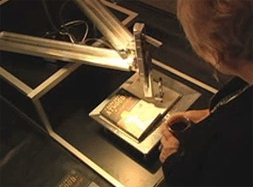
    Wow: Margaret Atwood has become the first author to sign books in remote locations -- via a telepresence robot!


    Last fall, she hooked up with a Toronto company called Unotchit (which sounds roughly like "you no touch it") that developed a device that works like this: Unotchit sets up its robot in a remote bookstore. Atwood logs in from home, and using a webcam, talks to people who are attending the far-off book-signing. She chats with 'em, asks what they want inscribed on their book, and they lay it in front of the Unotchit robot. Atwood writes on a screen, and the robot replicates her pen-strokes precisely, in real-time, on the book.

    Previous posts in the same row and isle:
  • Guided Imagery / Visualization - Uses with the Cancer Patron
  • Infomedia Revolution Revisited
  • Visual Communication Vistas Revisited
  • Scientists and Artists: Who should design learning?
  • The Technique of Song and Sound Visualization
  • January 13, 2007

    Information Visualization at Seth's blog


    I noticed two posts that add value to this blog

  • Turning your idea into a picture
    David at Boingboing points us to: A Periodic Table of Visualization Methods.
    I love the spectacular use of technology on this web page. I hate the twisted use of the periodic table (because the relationships between the types isn't natural or elegant the way chemicals are) but it's worth it, because it will certainly inspire you to figure out how to get out of your text rut.

  • Two kinds of people in the world...


    NB. As a bonus to this visualization (not from Seth's Blog), see also: Writing Style, By Gender posted at Jerry’s Blog–Because Wit Happens

    Here’s an interesting site where you can paste in some text and, based on a mathematical algorithm (there’s a link to the scientific paper), the text is analyzed and can generally make a pretty accurate determination as to whether the text was written by a man or a woman. (Be sure and scroll down after you’ve tried this to see which words you’ve used are considered “male” and “female”).

    Technorati tags: Sethgodin

    [image courtesy: Idle Advice]
  • January 08, 2007

    Graphic novels being challenged by parents

    Posted by the Asbury Park Press on 12/21/06
    BY DAVID TWIDDY
    THE CIATED PRESS

    KANSAS CITY, Mo. — When Amy Crump took over as director of the Marshall Public Library in central Missouri two years ago, she decided to build up the library's offerings for young adults by buying the literary world's hot new thing …graphic novels.

    "The bulk of our graphic novels are for young adults and they're very popular,'' Crump said, estimating the library's collection has gone from only a handful to around 75.

    Among the new acquisitions was "Blankets'' by Craig Thompson and "Fun Home: A Family Tragicomic'' by Alison Bechdel, two semi-autobiographical accounts of the respective authors' turbulent childhoods that include ruminations on strict
    religious upbringing and homosexuality.

    The two novels touched off what Crump said was the first challenge of library materials in Marshall's 16-year history, as parents complained that the books, which include pictures of a naked couple, could be read by children, attracted by the comic book-like drawings. Continue reading the full story


    Previous post:
  • Scientists study Christie success - Quantification to see true color of words