On the same shelf:
Showing posts with label Faithwise. Show all posts
Showing posts with label Faithwise. Show all posts
September 19, 2011
The Adhan in British Sign Language - audio and visuals synchronized
Info courtesy: Exploring Life, The Universe and Everything and Deborah L. Birkett
On the same shelf:
Salah Interpreted For Deaf Muslims pt.1 - YouTube
Publishing of Salat in sign language
FREE Mobile Athan having Liberia School Of The Deaf prayer times for Cell Phone
visually impaired Muslims -- Revert Muslims Assoc.
On the same shelf:


August 03, 2010
Ramadan Highway Code - Visualization - Do's & Don'ts

see also:
Info courtesy: Mohammed Ibrahim
May 03, 2008
Walk the Talk With Dr. Edward de Bono and get one-minute primer on the six hats
 Edward de Bono, Thought Guru makes people not only think about how they think, but also use new ways of looking at things to invent products, find solutions to persistent problems, and resolve conflict. In an interview with The Indian Express Editor-in-Chief Shekhar Gupta on NDTV 24x7's Walk the Talk, Dr de Bono talks about some of his thinking tools, how his training in medicine helped him arrive at some of his concepts, and about his meetings with Rajiv Gandhi, Dr A.P.J. Abdul Kalam, and Pervez Musharraf.
 Extract: If you give computers to young children, they start to believe that you don't have to think, all you have to do is search, and you'll find the answer. So, using computers is excellent, but you need, at the same time, to think. Now that extends beyond school. I've worked with major corporates throughout the world and they develop a habit of saying, 'Put all the information, all the information or data, into our computers, and our computers will analyse the data and that will set our strategy, make our decisions.' Very dangerous. Because unless you can look at the information in different ways, you are not going to make progress. And that's happening worldwide with the biggest corporates.
You know something interesting about Islam? The Prophet Muhammad had more to say about thinking than any other religious leader.
•In the Hadith, he says, 'One hour of thinking is better than 70 years of praying.' He says, 'The ink of a scholar is more holy than the blood of a martyr.' He says, 'One learned man gives more trouble to the Devil than a thousand worshippers.' That's Mohammad. In the Koran there are 130 verses about thinking. So, actually, when I go to the Middle East and tell them this, they don't know.Give me a one-minute primer on the six hats. How does it work?
... So the six hats separate out the thinking. Under the white hat, everyone is looking for facts, information, what we have, what we need, what questions have we asked, how do we get the information. Red hat: permission to put forward your emotions, your intuition, without having to justify or explain it. Black hat is critical: what is wrong, the risks, the downside, why it may not work. The yellow hat: values, benefits. The green hat: creative, new ideas, possibilities, alternatives and so on. The blue hat is the organizing hat: summary, outcome. The point is everyone is wearing the same hat at the same time. That's parallel thinking. That's important. Let me give an example. In a normal meeting, we may have someone who is against the idea being discussed. Normally, that person will spend the whole meeting attacking the idea. With the hats, under the black hat, he or she will be encouraged to be as critical as he or she can possibly be. Then, when it's the turn of the other hat, he's expected to look for value. And if he says, 'I can't see any value', and everyone else is seeing value, then he's seen to be stupid. So everyone is challenged to use their brain fully. continue reading
February 15, 2008
Visualizing the holy books

"This visualization, by Philipp Steinweber and Andreas Koller, comes from the textual analysis of different religions’ holy books (red = Hinduism, yellow = Buddhism, green = Islam, blue = Judaism, purple = Christianity). Below each character is a list of verbs associated with him or her in each religion." continue reading: Visualization: Character Relationships across Religions From SimilarDiversity.net
- Biblical infographic diagrams: a collection of scripturally-correct infogr
aphic diagrams outlining several major biblical concepts, including "The Seven Thousand Years Of Human History", "The Heavens", "The Resurrections and Judgments", or "The Failure Of Man". these information diagrams were made by Clarence Larkin about 75 year ago &, while appearing sparse at first, seem to pack a lot of information into a concise format.
- Chris Harrison: Visualizing the Bible
- Visualizing the innernet @ Multifaith Information Gateway
- More charts, maps, and graphical visualization of the Bible, as attempted by Clarence Larkin:

January 08, 2007
Graphic novels being challenged by parents
Posted by the Asbury Park Press on 12/21/06
BY DAVID TWIDDY
THE CIATED PRESS
KANSAS CITY, Mo. — When Amy Crump took over as director of the Marshall Public Library in central Missouri two years ago, she decided to build up the library's offerings for young adults by buying the literary world's hot new thing …graphic novels.
"The bulk of our graphic novels are for young adults and they're very popular,'' Crump said, estimating the library's collection has gone from only a handful to around 75.
Among the new acquisitions was "Blankets'' by Craig Thompson and "Fun Home: A Family Tragicomic'' by Alison Bechdel, two semi-autobiographical accounts of the respective authors' turbulent childhoods that include ruminations on strict
religious upbringing and homosexuality.
The two novels touched off what Crump said was the first challenge of library materials in Marshall's 16-year history, as parents complained that the books, which include pictures of a naked couple, could be read by children, attracted by the comic book-like drawings. Continue reading the full story
Previous post:
June 13, 2006
Visualizing the Innernet or Visual Display of the Website's Infostructure
Show, don't tell, is the bottom line here.
Websites have their own faces, features, facets, and factbites. Many are however not visualized. Interestingly, businesses and communication portals are now looking (not just at the surface and beyond), even at the inner self. This soul searching is good and hope it lasts longer. By the way, I am not alone in inviting attention to the Innernet (no spelling error) in a material world***
What follows is a visual of my two blogs' (or Website's) infostructure (not infrastructure, for a difference click here). Click at any of the images, given below and you can visualize the true colors of the content.
Image on the right: Multifaith Hall of Fame of the 21st century
Image on the left: Blog As A Teaching Tool
The meaning of the colors in the above images is well stated by the author of aharef. See the following:
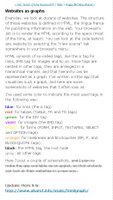
Acknowledgement: Thanks to Teblog of David Tebbutt for the information visualization tool, viz., Aharef's website-mapper.
I am amzaed by the way Ted has visualized this graphics: Website Structure (beautifully) Revealed [details]. His tell tale is:
Ted has identified another source: Aharef’s Wikipedia site-map. Click and Visualize
Incidentally, he was inspired by a master visualizer, Guillaume du Gardier. I envy Guillaume du Gardier for his PR and Communication skills. His blog is loaded (I mean it in a positive sense) with all types of graphics, images, and visuals [view here].
A word about other graphics and applications that pre-date Aharef's website-mapper.
Knowledge managers have been adopting this sense-making approach in their own ways. See Lennart Björneborn's doctoal work,
The Corona model with examples of link paths and reachability structures between different graph components in a web space (modified after the Bow-Tie model by Broder et al. 2000) [Details]
P.S. "I didn't say a word. They did." Thus Spake Feroze Thank you Mr. Feroze for giving me this message in seven short words (amidst your thousand worded blog). You are a creative visualizer (see his blog: my1000words). Thank you also for letting me learn that visuals speak on their own (we don't need to always use a 1000 words).
----
Similar Resources:
*** There are many more in this stream to give you such an insight:
Cover story of the May / June 2006 AIIM E-Doc Magazine, has a lead article on Be Serene: Channel you inner records manager, detials
Centre for Spirituality at Work "Fostering good karma a touchy subject; Spirituality is the 'last frontier' of workplace enightenment, but Wallace Immen finds interest in exploding, May 24, 2006 [You may find these articles of interest: An article from the www.Spirituality.com website about our Founding Director, Sherry Connolly, MBA, MDiv, DMin (cand.)]
Putting Reflection into Gear, BY : John Baldoni, [ON LEADERSHIP COMMUNICATION] 06/28/2006
Vertical and tacit: Multifaith and Knowledge Management in Perspective, details
Labyrinths, Sacred Geometry, Innernet & Visualization, details
See also: Richmond, Lewis. Work as a spiritual practice : a practical Buddhist approach to inner growth and satisfaction on the job (Broadway Books, c1999)
Websites have their own faces, features, facets, and factbites. Many are however not visualized. Interestingly, businesses and communication portals are now looking (not just at the surface and beyond), even at the inner self. This soul searching is good and hope it lasts longer. By the way, I am not alone in inviting attention to the Innernet (no spelling error) in a material world***
What follows is a visual of my two blogs' (or Website's) infostructure (not infrastructure, for a difference click here). Click at any of the images, given below and you can visualize the true colors of the content.
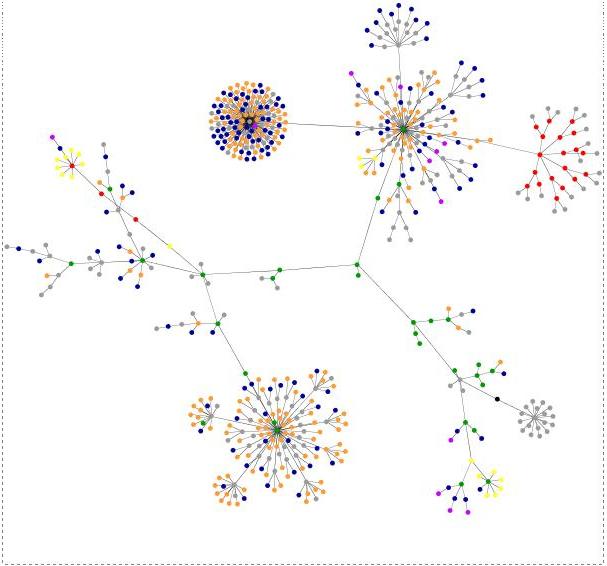 |  |
Image on the right: Multifaith Hall of Fame of the 21st century
Image on the left: Blog As A Teaching Tool
The meaning of the colors in the above images is well stated by the author of aharef. See the following:
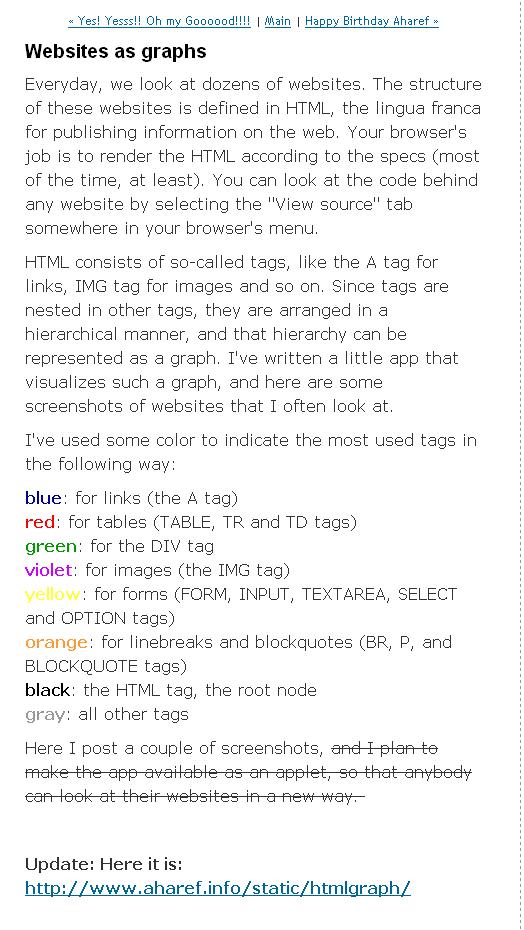
Acknowledgement: Thanks to Teblog of David Tebbutt for the information visualization tool, viz., Aharef's website-mapper.
I am amzaed by the way Ted has visualized this graphics: Website Structure (beautifully) Revealed [details]. His tell tale is:
As a way of highlighting areas for improvement, this is brilliant. It is also quite hypnotic to watch the image evolve.
Ted has identified another source: Aharef’s Wikipedia site-map. Click and Visualize
Incidentally, he was inspired by a master visualizer, Guillaume du Gardier. I envy Guillaume du Gardier for his PR and Communication skills. His blog is loaded (I mean it in a positive sense) with all types of graphics, images, and visuals [view here].
A word about other graphics and applications that pre-date Aharef's website-mapper.
Knowledge managers have been adopting this sense-making approach in their own ways. See Lennart Björneborn's doctoal work,
The Corona model with examples of link paths and reachability structures between different graph components in a web space (modified after the Bow-Tie model by Broder et al. 2000) [Details]
~~~~Links are for use – the very essence of hypertext;
~~~~Every surfer his or her link – the rich diversity of links across topics and genres;
~~~~Every link its surfer – ditto;
~~~~Save the time of the surfer – visualizing web clusters and small-world shortcuts;
~~~~The Web is a growing organism
quoted in PhD dissertation in webometrics:
Small-World Link Structures across an Academic Web Space - a Library and Information Science Approach.
P.S. "I didn't say a word. They did." Thus Spake Feroze Thank you Mr. Feroze for giving me this message in seven short words (amidst your thousand worded blog). You are a creative visualizer (see his blog: my1000words). Thank you also for letting me learn that visuals speak on their own (we don't need to always use a 1000 words).
----
Similar Resources:
*** There are many more in this stream to give you such an insight:
April 16, 2006
Labyrinths, Sacred Geometry, Innernet & Visualization
In Greek mythology, the Labyrinth was an elaborate mazelike structure constructed for King Minos of Crete and designed by the legendary artificer Daedalus to hold the Minotaur, a creature that was half man and half bull and was eventually killed by the Athenian hero Theseus. Theseus was aided by Ariadne, who provided him with a fateful thread to wind his way back again. source: Wikipedia See also Electronic Labyrinths
A labyrinth and its relationship with sacred geometry is best illustrated in the following words:
"Sacred geometry is the act of studying the divine act of creation and then using that knowledge to create in the same way. By studying nature, we find that the basic building blocks of creation are geometric. Since a divine hand is responsible for originating the numbers and proportions of the manifest universe, that geometry is sacred. Studying sacred geometry leads us to truth and self-understanding. All societies use sacred geometry to construct their temples, sacred places, and art. Chartres Cathedral, for example. And its labyrinth. Numbers aren't just for counting, nor are they just symbolic. They are the actual essence of everything that exists." Robert Ferré’s Definition
Innernet, according to Linda Johnson, is a part of self-realization. Linda states in the Chapter on ‘Turning on your inner light:
For most Hindus, Self-realization is God-realization. How can this be? ‘The air closed inside a jar is not at all different from the air outside the jar,’ said Shankaracharya. ‘In exactly the same way, your Inner Self is exactly identical with the Self of all. Smash the jar and the air inside it merges seamlessly with the air outside. Smash the illusion that you exist apart from God, and you merge in that divine reality…Think about it. Just as your five fingers are not really separate because they are linked to the same hand, so the Self in you and the Self in me (and the Self in Lassie the dog for that matter) are not really separate because they are linked in the Supreme Self, the consciousness of God.’ source: Linda Johnson. Complete Idiot’s Guide to Hinduism (New York, Alpha Books, 2002). 112. Google for innernet
A real-time connection of all of the above is visualized in the following:
"Occultism has always involved three techniques for changing and creating reality: thinking, speaking, and visualizing." Visualization and the Imagination
"Walking a Labyrinth is a personal meditative activity and can be understood as a path of contemplation or prayer for people in seeking the Divine or seeking peace without regard to any particular religious tradition."—The Hingham Journal, 9/04 LABYRINTHS, Prayer Paths That Promote the Occult.
See also a Listmania at Amazon.com : Changing One's Inner Compass
PS. My second blog Multifaith Information Gateway has more content, context, communication and continuity in the area of religious and spiritual worldviews.
January 31, 2006
Mindfulness visualized - A faith-based perspective
How do the faithful use mindfulness in order to find solace, healing, peace, etc.?
See: Visual Dhikr - Contemporary Islamic Art
See also:
..."Visual Remembrance and the Democratic Sublime," co-authored with John Louis Lucaites, Conference on Visual Rhetorics, University of Iowa, August 2000 source
...Huntsville Center for Conscious Living: Spiritual Peacemaking Taken Personally
...Where's Mork when you need him?, Reviews Written by
A. Joseph Haschka (Glendale, CA USA)
Those vignettes can be edited by a "Cutter" to create a visual remembrance of the deceased. A sort of "This Is the Best of Your Life" souvenir for the survivors. Alan Hakman (Robin Williams) is such a Cutter, one of the best in the business when it comes to cleaning up a depraved life's visual record into something suitable for family viewing at the wake.
...Dr Helena Miller, Should we integrate the Visual Arts with Religious Education? A Jewish Perspective - May 2001. FARMINGTON PAPERS PUBLISHED
Subzero Blue: Echoing the voices inside my head...
While surfing around the web, I came across the site Visual Dhikr, which is for an art project launched by two UK Muslim artists Ruh Al-'Alam and Abu Taha.
Visual Dhikr aims to help nurture the revival of Islamic Art in a contemporary fashion that compliments our lives, in our home, in the modern age.
See: Visual Dhikr - Contemporary Islamic Art
The Visualization Sourcebook: Using Imagination, Intuition, and Mindfulness to Heal Ourselves, Our Communities, and Our Planet
Margo Adair
Universoulightforms! Psychedelic Lightshow Artwork
We are a Visual Arts Laboratory dedicated to bringing you collectible
psychedelic lightshow art.
See also:
..."Visual Remembrance and the Democratic Sublime," co-authored with John Louis Lucaites, Conference on Visual Rhetorics, University of Iowa, August 2000 source
...Huntsville Center for Conscious Living: Spiritual Peacemaking Taken Personally
...Where's Mork when you need him?, Reviews Written by
A. Joseph Haschka (Glendale, CA USA)
Those vignettes can be edited by a "Cutter" to create a visual remembrance of the deceased. A sort of "This Is the Best of Your Life" souvenir for the survivors. Alan Hakman (Robin Williams) is such a Cutter, one of the best in the business when it comes to cleaning up a depraved life's visual record into something suitable for family viewing at the wake.
...Dr Helena Miller, Should we integrate the Visual Arts with Religious Education? A Jewish Perspective - May 2001. FARMINGTON PAPERS PUBLISHED
January 20, 2006
The Hajj Stampede in Graphics - Visualization of the pathway
Did you know about the following: Hajj, Mina, Jamarat Bridge's Tragedy - 2006?
From Other Blogspheres:
...Jamarah Plans
...Hajj tragedy: Eyewitness accounts
...HAVE YOUR SAY Are you affected?
See Also:
>>Visualization/Imagination And Islam
>>Almusawwir:
Huwa Allah, Creator, Originater, Shaper (Al Musawwir), To Hu belong The Most Beautiful Names (Quran 59.24).
The stoning ritual at Mina, outside Mecca, is one of the most dangerous aspects of the annual Hajj pilgrimage. Thursday’s stampede, in which atleast 262 people died, happened on the entrance ramp to the Jamarat Bridge as pilgrims thronged to cast stones at three pillars representing the devil. more... Alternative source: BBC's In graphics: Hajj stampede
From Other Blogspheres:
...Jamarah Plans
...Hajj tragedy: Eyewitness accounts
...HAVE YOUR SAY Are you affected?
See Also:
>>Visualization/Imagination And Islam
>>Almusawwir:
Huwa Allah, Creator, Originater, Shaper (Al Musawwir), To Hu belong The Most Beautiful Names (Quran 59.24).
A wonderful tradition of Islam are the 99 beautiful names of God, or the Asma Al Husna
Al Musawwir, being one of the names.
A possible interpertation of this name is The Bestower of Beautiful Forms.
Sheikh Ibn al-Arabi says: "Know that the divine beauty through which God is named "Beautiful," and by which he described Himself in His messenger's words, "He loves beauty," is in all things. There is nothing but beauty, for God created the cosmos only in His form, and He is beautiful. Hence all cosmos is beautiful." ... A sound report has come in the Sahih of Muslim from God's Messenger that he said "God is beautiful, and He loves beauty." He is the artisan of the cosmos, and He gave it existence in His form. (The Self Disclosure of God - William Chittick - pp. 28, 29). continued
December 31, 2005
How Observant Are You?
While mind and calender change the respective interfaces, please visualize my observation benchmark (upto 2005). I am A C! Are you in the same boat. If yes I am happy: 'great minds think alike.' If not try your luck, click at the bottom of this image and observe.
Want an observant HTML?
Thanks to a Canadian who brought me here
Your Observation Skills Get A C- |
 You tend to notice the big things in life... But the details aren't exactly your forte |
Want an observant HTML?
Thanks to a Canadian who brought me here
December 25, 2005
Cyber Worship - Look & Feel
My new book from Scarecrow Press. Due to be released shortly.
Interestingly, I found two blogs mention this phrase: Cyber Worship: [Faith] Cyber-members and Knowledge
About my book:
Cyber Worship in Multifaith Perspectives explores worship on the Net. It is not about ‘everything you need to know’ even on the subjects of faith & belief. This book is just about religious and spiritual experience under the rubric, cyber worship --worship as (Prayer, Praise, Scripture, Sacrament, Rituals, Confessions, Eucharist, Rites, Pilgrimages, Reflection, Contemplation, etc.) performed in cyberspace. The term ‘Cyber Worship’ includes variants, such as, religions-online, online-religions, religions on the Net, religions in the cyberspace, online worship, virtual worship, electronic prayer, cyber church, e-prarthana, cyber puja, cyber salat, cyber Hajj, cyber synagogue, cyber Minyan, so on and so forth.
Neither, cyber worship is a rival temple, nor multifaith a new religion. Here in a generic sense Multifaith is used to signify multiple faiths representing a unity in diversity. It includes first, mainstream religions & spirituality, and second alternative traditions of belief & practice. Alternative traditions, here include, alternative systems of belief religious practices, non-mainstream spiritualities, new age movements, non-traditional movements, paganism, non-conformists, cults, etc.
Contents (brief)
•Preface ix
•Credits: Copyright and Permission xi
•1. Cyber Worship/Meditation Webwise: Noah, Abraham and Beyond 1
•2. Cyber Worship as-is On the Web 67
•3. Fast Track to Multifaith Resources for Cyber Worship 109
•4. Navigating the Deep Sacred Space via Experiences of the Wise 137
•5. Glossary: A Pathfinder for Future History 301
•5.1 Appendix: Cyber Worship’s Web Feet: Metadata for Digital Information – Webliography 314
•5.2 Appendix: Cyber Worship: Web Evaluation - Questionnaire and Survey Results 314
•Bibliography 325
•Index 329
Ask for more info.
My other books
Interestingly, I found two blogs mention this phrase: Cyber Worship: [Faith] Cyber-members and Knowledge
A Sensational Development in the Cyber World (The Hindu Newspaper (17/07/03)!
A recent research in the University of Buffalo on Virtual Reality indicates the possibility to transmit the "Sense of Touch" though Internet. After the progress in transmission of "Smell" through Internet and "Connectivity" through "Fabric", the new possibility opens up avenues for the use of Internet in creating virtual reality through remote networking.
Ms. K. Sowmya and V.Vishwadhara, students, St Joseph's College of Engineering, Chennai have demonstrated the concept of "Experiencing Smell Through Electronic Reality" (ESTER) through a prototype of a "Scented e-card" in front of an international audience in Los Angeles (Indian Express (8/7/2003, City Express, Chennai).
In 2001 the Delhi based Sandeep Jaidka and Kewal Kohli obtained the world's first patent on the creation of smell and sensation through multimedia from the United States Patent Office. This invention relied on digitally encoded signals to produce a variety of sensations not specific to an enclosed or open space. Hopefully the Cyber World will be soon open to the third sensory dimension of smell beyond the senses of vision and audio. More
About my book:
Cyber Worship in Multifaith Perspectives explores worship on the Net. It is not about ‘everything you need to know’ even on the subjects of faith & belief. This book is just about religious and spiritual experience under the rubric, cyber worship --worship as (Prayer, Praise, Scripture, Sacrament, Rituals, Confessions, Eucharist, Rites, Pilgrimages, Reflection, Contemplation, etc.) performed in cyberspace. The term ‘Cyber Worship’ includes variants, such as, religions-online, online-religions, religions on the Net, religions in the cyberspace, online worship, virtual worship, electronic prayer, cyber church, e-prarthana, cyber puja, cyber salat, cyber Hajj, cyber synagogue, cyber Minyan, so on and so forth.
Neither, cyber worship is a rival temple, nor multifaith a new religion. Here in a generic sense Multifaith is used to signify multiple faiths representing a unity in diversity. It includes first, mainstream religions & spirituality, and second alternative traditions of belief & practice. Alternative traditions, here include, alternative systems of belief religious practices, non-mainstream spiritualities, new age movements, non-traditional movements, paganism, non-conformists, cults, etc.
Contents (brief)
•Preface ix
•Credits: Copyright and Permission xi
•1. Cyber Worship/Meditation Webwise: Noah, Abraham and Beyond 1
•2. Cyber Worship as-is On the Web 67
•3. Fast Track to Multifaith Resources for Cyber Worship 109
•4. Navigating the Deep Sacred Space via Experiences of the Wise 137
•5. Glossary: A Pathfinder for Future History 301
•5.1 Appendix: Cyber Worship’s Web Feet: Metadata for Digital Information – Webliography 314
•5.2 Appendix: Cyber Worship: Web Evaluation - Questionnaire and Survey Results 314
•Bibliography 325
•Index 329
Ask for more info.
My other books
Subscribe to:
Posts (Atom)