Showing posts with label Sound. Show all posts
Showing posts with label Sound. Show all posts
November 25, 2012
The Holy Qu'ran in ASL Demonstration


September 19, 2011
The Adhan in British Sign Language - audio and visuals synchronized
Info courtesy: Exploring Life, The Universe and Everything and Deborah L. Birkett
On the same shelf:
Salah Interpreted For Deaf Muslims pt.1 - YouTube
Publishing of Salat in sign language
FREE Mobile Athan having Liberia School Of The Deaf prayer times for Cell Phone
visually impaired Muslims -- Revert Muslims Assoc.
On the same shelf:
October 10, 2007
Web Analytics and Qualitative Insight: Listen.See.Smell.Taste.Touch
PS. In the following is an attempt by an expert to demystify Web Analytics. While most often heard is why or the quantitative and that which tends to excite, herein is what or the qualitative insight--i.e., the other side of the coin.
"2 Simple Steps to Finding Your Website's Voice" @ GrokDotCom: byHolly Buchanan
Posted in Branding and Advertising Rants | Persuasive Online Copywriting | Articles | Persuasive Copywriting | Customer Experience | Copywriting | Relationship Building
"When you have a conversation with a human being (as opposed to having a conversation with a cat, which if you've ever owned one, you know how well that goes) you get a sense of that person's personality. The clothes they wear, their tone of voice, how they move, the words they use - all of this gives you insight into who the person is.Every website visit is a conversation. Think about it. The web is an interactive medium. Every time you click you ask a question. You interact with the company or brand. What kind of answers are you getting? Do you get a sense of whom you are talking to? Do you have any sense of who the company/brand is?
I'm hearing a resounding answer of, "Not so much."
Your design, images, and copy all combine to convey your company or brand's personality. Of all of these, I would argue that copy is perhaps the most important element for conveying your website's personality or voice. As a copywriter, there are two things you must do:
1 - Have a clear understanding of your personality, brand or voice
2 - Convey that personality, brand or voice to your audienceHere are suggestions for how to accomplish this.
Step One: How to clarify your company's personality, brand or voice ...
Step Two: How to convey that voice in your copy ...
click here and continue reading
May 28, 2007
Silence Please: Mr. Bean, The Library
PS. The producers want to make clear that no real librarians were hurt in the filming of this skit [source: Law Librarian Blog] -- TV Series: "Mr. Bean" (1990).
[PS. Above info courtesy: David P. Dillard]
See also from my blogs:
Funny you should ask: Humor at the Reference Desk
Unusual Reference Questions - Globalism Visited
Seneca Library Holiday Song
The Technique of Song and Sound Visualization: Blogga Song of Librarians
[PS. Above info courtesy: David P. Dillard]
See also from my blogs:
February 03, 2007
Sight, Sound, Senses Visualized - Creative Innovations in Touch and Tell Spheres
[NB. Rest in the Waiting: smell, taste, touch]
Web site helps name that tune in your head [Sify.com] 
Singapore: You know that annoying tune that you can't place or get out of your head? A US company has recently launched a Web site, www.midomi.com, that names most tunes that you can hum, sing or whistle a tune into your computer microphone. [Image source and more details: Website Lets Users Search For Unknown Tunes That Get Stuck In Their Head, Thursday February 1, 2007]
Librarians will see Margaret Atwood's Long Pen for the first time at the Ontario Library Association Super Conference's THE 2007 EXPOSITION, Feb 1 -2, 2007
Margaret Atwood's telepresence book-signing robot Clive Thompson, March 01, 2006
Wow: Margaret Atwood has become the first author to sign books in remote locations -- via a telepresence robot!

Last fall, she hooked up with a Toronto company called Unotchit (which sounds roughly like "you no touch it") that developed a device that works like this: Unotchit sets up its robot in a remote bookstore. Atwood logs in from home, and using a webcam, talks to people who are attending the far-off book-signing. She chats with 'em, asks what they want inscribed on their book, and they lay it in front of the Unotchit robot. Atwood writes on a screen, and the robot replicates her pen-strokes precisely, in real-time, on the book.
Previous posts in the same row and isle:
Guided Imagery / Visualization - Uses with the Cancer Patron
Infomedia Revolution Revisited
Visual Communication Vistas Revisited
Scientists and Artists: Who should design learning?
The Technique of Song and Sound Visualization

Singapore: You know that annoying tune that you can't place or get out of your head? A US company has recently launched a Web site, www.midomi.com, that names most tunes that you can hum, sing or whistle a tune into your computer microphone. [Image source and more details: Website Lets Users Search For Unknown Tunes That Get Stuck In Their Head, Thursday February 1, 2007]
Wow: Margaret Atwood has become the first author to sign books in remote locations -- via a telepresence robot!
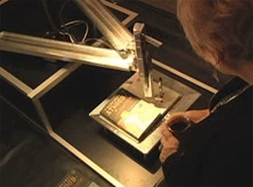
Last fall, she hooked up with a Toronto company called Unotchit (which sounds roughly like "you no touch it") that developed a device that works like this: Unotchit sets up its robot in a remote bookstore. Atwood logs in from home, and using a webcam, talks to people who are attending the far-off book-signing. She chats with 'em, asks what they want inscribed on their book, and they lay it in front of the Unotchit robot. Atwood writes on a screen, and the robot replicates her pen-strokes precisely, in real-time, on the book.
Previous posts in the same row and isle:
May 28, 2006
Visual Communication Vistas Revisited
What a co-incidence (serendipity is not in fashion, any more)!!!
Oops! Some including the founder of the Web, nevertheless comfortably call this process of finding the unexpected Web resources, as serendipity.
View his words:
Thanks to Dave for such a thoughtful blog, viz., Communication Nation.
Anyways, I found three interesting Visual Communication resources:
A quote that is very relevant here:
Communication Nation, by dave gray, Founder and CEO of XPLANE, the visual thinking company.
Herein, I enjoyed Visual thinking with Legos
Visual Mind - Mind Mapping Software:
What do you think about this content, as well as, approach to communications? Does the above help you in adding value to business & / or daily life; or what have you to add on, please bring in, asap.
Note: This is a sequel to my previous Visual Communication vistas
Similar entries:
Books and senses - visualization conceptualized again
Guided Imagery / Visualization - Uses with the Cancer Patron
The Technique of Song and Sound Visualization
See also, my other blog's post: Knowledge Management Applications in Multifaith & / or Multicultural Transactions
Oops! Some including the founder of the Web, nevertheless comfortably call this process of finding the unexpected Web resources, as serendipity.
View his words:
But, let me add a message (before it is lost in the medium). I did a post in my previous blog on anti-social networking (READ: Isolatr Vis-a-Vis unifier on the Web ). And, today I found a blog that links social communication using the media and a medium."You get this tremendous serendipity where I can search the internet and come across a site that I did not set out to look for." Tim Berners-Lee, in Web inventor warns of 'dark' net, BBC News, To Listen to him voice and watch the video here
Thanks to Dave for such a thoughtful blog, viz., Communication Nation.
Anyways, I found three interesting Visual Communication resources:
“The events communicate in a variety of ways -- the spoken word, the visual -- and we don't bypass the opportunity to communicate in the visual. In fact we invest in it. After all, sometimes it's the visuals that get you into the news,” Rob Stutzman at thinkexist.com
Herein, I enjoyed Visual thinking with Legos
Visual Mind is a powerful tool that will help you in your daily work, whether the purpose is business or personal related.
Through a mind friendly and simple to use interface, you can visualize your thinking, quickly arrange and organize your work, all to benefit you as well as people around you.
What do you think about this content, as well as, approach to communications? Does the above help you in adding value to business & / or daily life; or what have you to add on, please bring in, asap.
Note: This is a sequel to my previous Visual Communication vistas
Similar entries:
May 21, 2006
Scientists and Artists: Who should design learning?
An interesting perspective, indeed!!! The above title is from an article posted by Gsiemens, at the Connectivism Blog.
[P.S. Incidentally, I tried to leave my comment on the same page, but the blog requires registration. Hence, I post my comments here. I hope this will benefit all those who have not crossed this creative visualization]
Thank you gsiemens for the balanced approach in presenting the debate. Also thanks to Deirdre Bonnycastle for highlighting the (intrinsic and extrinsic) value of information visualization. Here, I reproduce the comment by Deirdre Bonnycastle
While it is proverbial to say a picture is worth a thousand words, I would quote the original author (to show the true colors): “Words and pictures can work together to communicate more powerfully than either alone.” This quote by William Albert Allard, interestingly, also supports the reason for the existence of my blog, viz., Information Visualization.
Back to the article and its debate - who is more competent. My comments are as follows:
[P.S. Incidentally, I tried to leave my comment on the same page, but the blog requires registration. Hence, I post my comments here. I hope this will benefit all those who have not crossed this creative visualization]
Thank you gsiemens for the balanced approach in presenting the debate. Also thanks to Deirdre Bonnycastle for highlighting the (intrinsic and extrinsic) value of information visualization. Here, I reproduce the comment by Deirdre Bonnycastle
Here's a question to ponder "Why are most educational Blogs full of words?" "What is it about the alphabet that consumes educational practice?"
While it is proverbial to say a picture is worth a thousand words, I would quote the original author (to show the true colors): “Words and pictures can work together to communicate more powerfully than either alone.” This quote by William Albert Allard, interestingly, also supports the reason for the existence of my blog, viz., Information Visualization.
Back to the article and its debate - who is more competent. My comments are as follows:
On the question who should design learning, my own answer will be (agreeing with the author), none of the above. I am a librarian, and understanding the process of educating the educators was my Fulbright project (more specifically, it was to get a feel of how user education program was implemented in American libraries, 1989-1990). I have taught library science for over fifteen years -- all without any formal training in the area of how-to-teach! Only recently I took a course (Teaching effectiveness Certificate), to get a look and feel of educational methodology. (Wherein, two courses are taught by a Nursing specialist).Interestingly, the Connectivism Blog -with its subtitle: Theory of how individuals and organizations learn in a digital ecology- has much more content, context and concerns for us as teachers.
Permit me to narrate my experience. I did a presentation in the above course. My presentation had three goals, viz., a) introducing the class to blogsphere, b) facilitating visualization of how blogs can be both entertaining and educative and c) present the results of my research on trends in blogging and blog as tool for the educators. View this research survey results at my blog: Blog As A Teaching Tool. At the end of the lecture, as a stimulant, I presented the Blogga song [See details of this on my blog: The Technique of Song and Sound Visualization]. Blogga song is by and for librarians, but entertains everyone.
What I learnt from this presentation is that the participants were motivated to a great extent by this lecture and the tools that I brought in. A few were familiar with the name blog, fewer had seen it, and finally I initiated them to be bloggers, at the end of day.
What I infer, from all the exposure and experience is, competencies and skills if shared collectively, and if digested professionally by any one, can result in producing good design and aid in good delivery.
Recall cases where teachers with master or doctoral degree in education have failed and failed badly in communicating actual sense of learning objectives (L/O) & / Or learning outcome (lot). The debate on the importance of such fundamental concepts continues even in this 21st century.
My belief is good teachers are not made; they are born.
May 09, 2006
Blog As A Teaching Tool
This will be a running post: Updated 2 March 2007
Blogging for Scholars
Does your prof blog? If he or she does, you had better know about it. Professors who blog do so for a variety of reasons. Some are musing aloud over new ideas or research that will later appear in scholarly journals and on your library's shelves, virtual or physical. Some are exploring new ways of expression or appealing to a larger audience than they get in the paid lecture hall. Or they may be trying out a side of themselves that they don't quite dare expose fact-to-face with their primary community Continue reading @ Emerald LibraryLink
The theme of this conference -- Unfolding the Future -- is focused on ways to enhance tomorrow's college and workplace environment. In our workshop, we have highlighted three of the emerging technologies -- Blackboard, Camtasia, and Weblogs -- and how they are being used at Shoreline Community College. Now we would like to hear from you...
If you are uncertain about how to do any of these steps, click here to go back and review. You may also listen by choosing "play this audio post" below. continue reading
Heads up: if you have any interest at all in teaching social software, you should read Teaching Social Software with Social Software by Ulises Mejias in the current issue of Innovate: Journal of Online Education (free registration required for full-text)...
As you can imagine, I was thrilled to stumble upon this article (thanks, Paul!), given the fact that I’ll be doing a bit of teaching-social-software-with-social-software myself this Fall. I was even more thrilled to find out that Innovate hosts webcasts with their authors, and Mejias’ webcast happens to be this Thursday at 12pm.
A Biological Blogger, July 14th, 2006
Paul Z. Myers, an associate professor of science and math at the University of Minnesota at Morris, is something of an accidental blogger: He only started after setting up a Web site for students enrolled in one of his courses...
How does a blog on developmental biology become such a big hit? Injecting a bit of politics into the proceedings doesn’t hurt: Mr. Myers, who bills himself on the blog as a “godless liberal,” mixes strongly worded attacks on creationism and intelligent design in with other “random biological ejaculations.” —Brock Read . Continue reading from A Biological Blogger. More of this Genre Webblogged at Blog Juice for Educational Technology
Not sure, what is this all about?
Hearing, seeing and listening may change your perception.
Here you go [just-in-case you want to be oriented towards this subject] with a :
TITLE: How and In Which Situations Web Logs or Blogs Work: How and Why They are Valuable in Children's Education
SPEAKER: David Weinberger
EVENT DATE: 11/15/2004
RUNNING TIME: 55 minutes. (Thanks to Web Capture @ Library of Congress for sharing this excellent speech)
I guess I am the ten zillionth person who is trying to visualize the above question. The deep web has this question and stated in umpteen ways. Nevertheless, the most common concerns include, viz.: a) the suitability of this tool to communicate; b) the compatibility of this tool in interactive learning process; and c) find WHAT WORKS, WHAT DOESN'T, WHAT'S PROMISING
Let us begin with a reflection on the process involved and visualize the whole picture:
"...These days it is rare to talk about a single function tool. Many discussion board providers now bill themselves as community software providers and bundle other tools into their products such as chat, instant messaging, polls, blogs, wikis, member directories and file sharing. So you will find some overlap between the first few sections of the tour and the groupware section! In addition, there is sometimes a split in communities where some like blogs and wikis and others prefer discussion boards. This split may be generational, but regardless of its origin, it is helpful to be aware of this and figure out how to bridge between the groups when picking tools."[source: Web Based Discussion Tools, in Tool Tour, by Nancy White. See also herein excellent illustrations and examples in "Social Software Tools (Blogs, Wiki's, and Other Creatures)."
I will summarize my findings. The Webliography at the end of this article will give a link to some significant resources.
A. Blogsavvy's prescription very valuable (value added because, it has received 53 comments, which would mean some thing that is really worth looking at!)
How NOT to use blogs in education:Never never approach blogs as discussion boards, listservs or learning management systems Group blogs are a bad idea and don’t work Don’t try and force blogging into something else Ignore RSS at your peril
B. Arguments for and against using Blog are equally educating, in the Blog by Anthony Moretti, and I quote:
Arguments for using Blog as a Tool:Young people are using this technology; they might not read as much as we would like them to, but they do blog (and love pods)!! Can foster creativity and expression; if this gets students to write, think, analyze; why not use it? Cheap; can be set up for no money and be used in a variety of ways Errors, omissions, biases, etc. can be caught
Arguments against using Blog as a Tool:Small audiences Staying power? Deciphering the junk from the credible
C. Despite the above inspiration, the Sixty Four Dollar question remains:
Well, they aren't awful. They are fashionable right now, and so may gain learner acceptance. They get learners to write, which is inherently good, and to express their opinions - which may or may not be a good thing. But there's a fundamental problem with blogs: They are essentially optimized for easily publishing one’s opinions on the web. This is fundamentally a flawed model for education. It promotes narcissism, not dialog.
D. And the wise continue the debate. The latest evidence-based wisdom comes in a podcast, "Blogs in education: podcast," delivered by Keith Burnett’s blog, and posted on April 2nd, 2006
Educational uses of blogs include: as class diary for a specific group of students, as notice-board for a whole cohort, and even as a space for students to write themselves.
Students producing their own blogs requires careful thought. Web pages are cached by search engines and can be held in ‘frozen’ form for years – for this reason students might want to post under an assumed name. You also need to check College regulations about external publication by students. Some students find having their own page to show off work a motivational factor. Some teachers use blogs as notice boards for whole cohorts of students. I would suggest switching off the commenting in this case and possibly adding an e-mail list facility so students can have new notices e-mailed to their inbox.
I find that I have most success with blogs used as class diaries – each class has a page. I can pop a summary of each lesson on the blog, and I can add links to Web pages with exercises, explanations, interactive quizzes or demonstrations. The blog can then be used by students who were at the lesson as a reminder of the main themes (and homework) and as a guide to carefully chosen and relevant Web pages. Students who had to miss all or part of the lesson can find a summary, possibly with text-book readings and some links that will enable the student to get the gist of the lesson and be able to join in a little more next week.
E. Research Prospects in this Area
Blogging is helping students to think and write more critically, says an Australian researcher, and can help draw out people who would otherwise not engage in debate.
These are the preliminary findings of PhD research by Anne Bartlett-Bragg, a lecturer at the University of Technology, Sydney, who has been using weblogs or blogs in her own teaching since 2001.
She says blogs are also extremely useful for categorising and managing a large collection of thoughts, whether they are from lecture notes, a student's own ideas, or comments on the ideas of others.
F. Webliography:
Vancouver, Canada October 24, 2005, ELEARN, Volume 2005, Issue 1.
Microsoft's technical evangelist Robert Scoble met recently with CW Executive Editor Natasha Spring and frequent CW contributor William Briggs to set the record straight on blogs, their impact on the media, whether companies have anything to fear from this new communication medium, and the release of his new book, Naked Conversations.
Online interactivity is becoming a valuable way of improving the communication quality of business web sites. As a result, it is important that web site designers understand the concept and how it affects the quality of web site design. This study empirically validated Ha and James' five interactivity dimensions (playfulness, connectedness, reciprocal communication, information collection, and choice) and their relationship to design quality. Continue Reading Improving the quality
Whatever one thinks about the structure of the internet as a whole, it is becoming increasingly clear that the particular architecture of the blogosphere is the chief impediment to its becoming a place where new ideas can be deployed, tested, and developed. Take, for instance, the problem of comments. Continue reading Goodbye
Using technology in teaching and learning: Resources to help you navigate a digital world, C&RL News, February 2007, Vol. 68, No. 2, by Bryan Alexander
Published online 2006 August 15. doi: 10.1186/1472-6920-6-41. [full text]
See also my previous posts:
Quotable quote from Library Stuff:
The power, posted December 19, 2003
Anna writes:
"There's something seriously wrong with the world when one innovative, blogging, rarin' librarian can have more links in a web directory than one of the most important theorists on classification and indexing."
That's the power of weblogs, especially in the library world. I'm not sure why this is surprising, however. Who is more likely to have more content on the web, Jessamyn or Ranganathan? You will probably find more information on Ranganathan in books (library science 101, etc), than Jessamyn. Also, as Greg so dutifully points out, most of the links are interviews. When was the last interview you read on Ranganathan?
April 05, 2006
Visual Communication vistas
UPDATE: CEO roundtable: Top tech players sound off about evolving industry, USA TODAY Updated 5/18/2006
Some interesting references that I came across
See also: Visual Architecture: The Rule of Three, By Carole Guevin, 2001
~~~Did You Know about Micosoft's Window Media Player's true colors?: Windows Media Player visualization is displayed when you playback ...
~~~Did you Know Real Player's true colors. Read all about these
---background music sonification, aesthetic & infovis
More in Google
The communications industry is getting flipped on its head and turned inside out. Instant messagers are turning into phones. Cellphones are turning into TVs. And that's only the beginning.
Some interesting references that I came across
Seeing Things Your Way: Information Visualization for a User-Centered Database of Computer Science Literature
I S I S Visual Communications
What's the Difference between Looking and Seeing?
See also: Visual Architecture: The Rule of Three, By Carole Guevin, 2001
Visual architecture is applied to the new media design context and defined as the use of a particular method of building visual information and balancing communication between images and words.
Visual architecture is to be distinguished from the way that Occidental languages train our eyes to read from left to right and from other languages as well, like oriental and middle-eastern ones, which train the eye differently.
The object of this article is not to discuss language eye training, but to point to the more universal language between words and visual objects (picture, illustration, graph, area boxing, layout, titling) and can be extrapolated to advertising, print, TV, Flash development and CD-ROM productions.
Synonyms would be: generating visual attention, or interest, to information presented.
~~~Did You Know about Micosoft's Window Media Player's true colors?: Windows Media Player visualization is displayed when you playback ...
~~~Did you Know Real Player's true colors. Read all about these
---background music sonification, aesthetic & infovis
More in Google
March 31, 2006
Information Visualization: From Aristotle, Plato, to the year 3706
There can be no words without images --- Aristotle
Of all the senses, trust only the sense of sight ---this is paraphrased, and taken from Metaphysics, Aristotle [E.&.O.E., info courtesy Anonymous Blogger]
In the mind’s eye:
This view of the word as preeminent is at odds with millennia of thought. Aristotle said, “There can be no words without images.” Plato gave primacy to sight over all the other senses, saying, “Of all the senses, trust only the sense of sight.” While intellectually extolling the virtue of text over image, Western culture has clearly retained a special place for images. Many of today’s most commonly used phrases suggest we agree with Aristotle and Plato that we perceive primarily through sight: “I see your point,” “Let me see,” “Seeing eye to eye,” “Love at first sight,” “See what I mean,” and, of course, “In the mind’s eye,” just to name a few.
We are, after all, a visual species. Yes, a scent, a taste, a sound, even the texture of an object can evoke powerful memories, but it is sight that adds definition. Think back to the last time you sensed a particular perfume or smelled a favorite food. What images came to mind? Read more from Professional communicators for a digital age, by Cameron Sanders. SOURCE: Creating Digital Content, John Rice & Brian McKernan, Editors, © McGraw-Hill 2001 · POSTED: 04/09/04
The Future historians' perspective:
Archeologists in the year 3706 uncovering the buried ruins of any major city in the world will no doubt find text on billboards, storefronts, traffic signs, and so on in the languages we know and use today. These words however will probably not be understood by 38th Century scientists because languages of today will eventually become obsolete and forgotten. Luckily, there will be an energetic and tenacious researcher with a well-used digging tool who will find along the viaducts and abandoned highways in the old cities evidence of writing that will be instantly recognized and easily read. For amid the buried rubble of civilizations long past will be elaborated and brightly colored signs and symbols created by graffiti artists that will last through the millennia. This often scoffed and criminalized form of visual communication will in the future become the one, universally accepted language. Therefore, the future of mass communications does not reply on the preservation of pens, paper, computers, or satellites. In the vast future, we will understand ancient civilizations because of compressed paint in spray cans. Continue reading Syntactic Theory of Visual Communication, by Paul Martin Lester, Ph.D.
See also: The Art & Practice of Creative Visualization by Ophiel - The Philosophers Stone The Art & Practice of Creative Visualization by Ophiel - There’s more to creative visualization than meets the eye! [ART & PRACTICE OF CREATIVE VISUALIZATION contains unusual, but highly effective prose style intended to appeal to a beginning down home, grass roots reader. The author provides a clear explanation of what visualization is, and why it works]
March 05, 2006
The Technique of Song and Sound Visualization
We have many such ode visualizers. Don't believe?
Listen and watch at Brian Smith, the Laughing Librarian's Blogga song. Copyright 2006 Brian Smith.
~~~~See also: Slashdot Song
~~~~Google for more song visualization in the blogsphere and sound visualization.
Thank you lalcorn in Library Stuff for getting me to this world of Blogga song.
Techies may like to get a feel from the following: Simulating Acoustic Fields. See also their case studies
Disclaimer: This blogsphere aims to disseminate information with malice towards none.
Listen and watch at Brian Smith, the Laughing Librarian's Blogga song. Copyright 2006 Brian Smith.
~~~~See also: Slashdot Song
~~~~Google for more song visualization in the blogsphere and sound visualization.
Thank you lalcorn in Library Stuff for getting me to this world of Blogga song.
Techies may like to get a feel from the following: Simulating Acoustic Fields. See also their case studies
Disclaimer: This blogsphere aims to disseminate information with malice towards none.
February 05, 2006
Guided Imagery / Visualization - Uses with the Cancer Patron
By Cheryl Warren, M.S.L.S., ValleyCare Health Library, Pleasanton, CAExcerpted from Cancer Librarians Section Newsletter, Spring 1999, Updated 2002 [Web site Last modified: 01-April-2003]
Guided imagery or visualization is a technique that uses the imagination to create vivid images that the body can perceive and respond to. Often described as focused day-dreaming, visualization is considered a complementary therapy that works well with traditional treatments. Guided imagery can ease stress, anxiety, enhance personal awareness, and improve psychological coping skills. Because visual imagery has numerous aspects and various components as well as techniques in application, the definitions can vary in meaning from practitioner to practitioner. Continued ...
Contents Include: Web Sites, Literature Search: Guided Imagery / Visualization and Cancer, Collection Development: Guided Imagery / Visualization (Books, Audio-visuals)
About Cheryl Warren who is now at: Las Positas College 3033 Collier Canyon Road Livermore, CA
January 26, 2006
Search engines & opinion research - Interactive information visualization
This will be a running post, updated July 17, 2007.
"The question-and-answer site Yahoo Answers is one of the most successful social interaction communities on the Web today. With 65 million questions posted on the site, it has become a social interacting phenomenon very much like YouTube or MySpace. According to ComScore, Yahoo Answers is now the second most popular Internet reference site after Wikipedia..." continue reading: How to Use Yahoo Answers to Promote Your Business @ PowerHomeBiz.com by By Isabel M. Isidro
Google Says Goodbye to Google Answers
Danny Sullivan reports that after more than four years Google Answers is shutting down. The service first launched in April 2002 with lots of attention from the library and information community. Since then both Yahoo (Yahoo Answers) and MSN (Windows Live QnA) have released Q&A services. Full story @ Gary Price's ResourceShelf
Yahoo Answers is Worth a Try
Wednesday, August 23, 2006
There have been lots of Web based Q&A services that promise custom answers from actual humans, ranging from fee-based ones like Google Answers (that works on an auction model) to the defunct FIND/SVP's "Ask an Expert" site, to various free services like Wondir.com and the various individual locality "ask a librarian" services, to of course your own public reference library. (As Gary Price noted here)Continue reading Intelligent Agent Blog
Yahoo has answers for Stephen Hawking and Bono, Posted by Dan Farber, @ ZDNet> Between the Lines July 7, 2006
Yahoo is turning to big names to pose large-grained questions on Yahoo Answers. Dr. Stephen Hawking poses the question: How can the human race survive the next hundred years?" Bono asks, "What can we do to make poverty history?. Between the two, there are over 34,000 responses so far. A good way to generate usage among the Yahoo community and discuss important topics, but not easy to sort through the answers unless you have alot of time to scan thousands of replies… continue reading Yahoo has answers
As a sociologist I find the concept of Google Answers far more fascinating than its content. I am reminded of game theory. The researchers seem to be behaving as though they are in competition with each other for prizes, and the prize, as usual in academic settings no less than in business, seems to be recognition. [source: Comments at Google Answers]
Interesting trend and reviews:
Yahoo answers is free, and this may offer another way to visualize the "open source" revolution. Does it sound so? With the opinions and impressions of the netizens, is this to become another eMarketing research tool?
Read and experience for yourself.
Yahoo Answers Will Kick Google Answers in the Seat of the Pants, What's Yahoo Answers? Glad you asked. December 8, 2005
The Birth of Yahoo Answers, Posted by Gary Price on Dec. 7, 2005
Why should I use Yahoo.Answers? How dependable is this source? Jan 25, 2006 at 10:54 am
Final Thoughts from Gary Price:
One day or even one month test to judge the popularity and usefulness of Yahoo Answers is not enough. It will take some time.
Like I said about the launch of Google Base the other week, I think it will be very illuminating to take a look at Yahoo Answers in a few months to see how the community has developed and also functioning on policing itself to remove spam, bad info, etc. Yahoo will need to be very vigilant to monitor:
Spam
Scams
Uses as a marketing tool (working in plugs for various products into answers).
Infomercials of a different sort.
Members who consistently cause problems
In other words, can the Yahoo Answers community of users police themselves or will Yahoo have to step in and be aggressive in their policing? Will Yahoo Answers simply be the next generation of an online bulletin board and online groups like Yahoo Groups which, unfortunately, deliver plenty of spam.
Also remember that no "answer" tool is perfect for every question. Different answer tools have their strengths and weaknesses. It's about using the correct one at the correct time. Sometimes a friend or colleague can provide you with the answers you need while sometimes you need someone to help you direct you to the correct tool to get the job done in a timely manner. Authority, currency, and related metrics still count!
Looking for some alternatives to consider? See my Other Q&A Services, Most Available For Free! post that's now up as a companion to this article, covering some other online Q&A services.
Postscript: If you're interested in taking the official Yahoo Answers product tour, here it is. Also, Yahoo has added a Yahoo Answers tab to the upper right corner of their clutter-free search.yahoo.com interface.
---------
Recent Analytics:
...1/23/2006. Yahoo Answers & Yahoo Publisher Network To Pay Users?
Let’s see, the future of Yahoo is Social Media. Social Media is interactive user generated content such as tagging, blogs, MyWeb, user reviews, photo sharing, ratings, and perhaps even user generated mashups (I’m thinking that Ning is an obvious acquisition target) and, oh yes, Yahoo Answers.
Using the same mentality as my Grandfather ("Hey, go wash my boat and I’ll give you $5.” Or “Here’s $5 kid, now scram."), Yahoo will be offering their registered members the ability to join the Yahoo Publisher Network and perhaps earn revenue towards the contextually targeted Yahoo Search Marketing ads which are shown on the Answers that those members contribute. Jen Slegg scooped the story today on her JenSense Blog (Best Contextual Advertising & Search Marketing Blog of 2005)
...Yahoo Misses Targets, Analysts Struggle for Answers, By Keith Regan
E-Commerce Times, 01/18/06 10:16 AM PT
There is little agreement among analysts on the impact of Yahoo's results on Google. Some raised their ratings on Google, assuming that it stole market share and revenue from Yahoo and stands to gain even more now that its partnership with America Online is in place.
...Yahoo Answers. Technologies of Cooperation, Posted by Mike Love, January 11, 2006 at 10:22 AM
(~~~~);See Also: yahoo versus google
a simple visualization that compares the order of the search results from yahoo & google.
January 03, 2006
Infomedia Revolution Revisited

This is a running post: Updated 15 Sept, 2006:
Infomedia has different names, (may be in a new bottle). See for instance what paidcontent.org's Rifat Ali has to say: "By social media we mean all the ways in which media, entertainment and information (MEI) industries are colliding with users as part of the mix." continue reading more about this social media...
A news item in National Post (Canada), January 3, 2006, carried header, A trade show this week will raise the curtain on gadgetry linking data, music and video -and a headline, "PCs, TVs together at last." This article originally appeared in New York Times, with a different title, as given below.
Data, Music, Video: Raising a Curtain on Future Gadgetry
By DAMON DARLIN
Published: January 2, 2006
... But the biggest trend expected at the International Consumer Electronics Show, which begins this week in Las Vegas, is that these machines will be communicating with one another. The theme of this year's show might best be described as Convergence: This Time We Mean It.
For more than a decade, manufacturers of consumer electronics like televisions and audio gear have talked about blending their products with personal computers, so that consumers can enjoy a seamless stream of data, video and music anywhere. It has not happened, because the two industries do not have compatible technology standards and the requisite high-speed Internet connections have not been widespread enough.
...
The Infomedia Revolution: How It Is Changing Our World and Your Life by Frank Koelsch [A glance at the contents gives a feel of what is this all about: Part I: The Infomedia Imperative, Part II: Home Sweet Electronic Home, Part III: The Information Superhighway, Part IV: Infomedia: Revolutionizing Business, Industry and Government, Part V: Changing Our Lives]
Book Info: Author gives us powerful insights into how technology is reshaping our world. This book is a welcome survey from a seasoned observer and analyst of the collision of the world's most powerful industries - media, telecommunications, entertainment and technology. DLC: Telecommunications.
... More by Frank Koelsch"
Bridging the business-IT divide - experts show how
...Google on Media Convergence
Technorati Tags:
Social Media
Info Media
December 25, 2005
Cyber Worship - Look & Feel
My new book from Scarecrow Press. Due to be released shortly.
Interestingly, I found two blogs mention this phrase: Cyber Worship: [Faith] Cyber-members and Knowledge
About my book:
Cyber Worship in Multifaith Perspectives explores worship on the Net. It is not about ‘everything you need to know’ even on the subjects of faith & belief. This book is just about religious and spiritual experience under the rubric, cyber worship --worship as (Prayer, Praise, Scripture, Sacrament, Rituals, Confessions, Eucharist, Rites, Pilgrimages, Reflection, Contemplation, etc.) performed in cyberspace. The term ‘Cyber Worship’ includes variants, such as, religions-online, online-religions, religions on the Net, religions in the cyberspace, online worship, virtual worship, electronic prayer, cyber church, e-prarthana, cyber puja, cyber salat, cyber Hajj, cyber synagogue, cyber Minyan, so on and so forth.
Neither, cyber worship is a rival temple, nor multifaith a new religion. Here in a generic sense Multifaith is used to signify multiple faiths representing a unity in diversity. It includes first, mainstream religions & spirituality, and second alternative traditions of belief & practice. Alternative traditions, here include, alternative systems of belief religious practices, non-mainstream spiritualities, new age movements, non-traditional movements, paganism, non-conformists, cults, etc.
Contents (brief)
•Preface ix
•Credits: Copyright and Permission xi
•1. Cyber Worship/Meditation Webwise: Noah, Abraham and Beyond 1
•2. Cyber Worship as-is On the Web 67
•3. Fast Track to Multifaith Resources for Cyber Worship 109
•4. Navigating the Deep Sacred Space via Experiences of the Wise 137
•5. Glossary: A Pathfinder for Future History 301
•5.1 Appendix: Cyber Worship’s Web Feet: Metadata for Digital Information – Webliography 314
•5.2 Appendix: Cyber Worship: Web Evaluation - Questionnaire and Survey Results 314
•Bibliography 325
•Index 329
Ask for more info.
My other books
Interestingly, I found two blogs mention this phrase: Cyber Worship: [Faith] Cyber-members and Knowledge
A Sensational Development in the Cyber World (The Hindu Newspaper (17/07/03)!
A recent research in the University of Buffalo on Virtual Reality indicates the possibility to transmit the "Sense of Touch" though Internet. After the progress in transmission of "Smell" through Internet and "Connectivity" through "Fabric", the new possibility opens up avenues for the use of Internet in creating virtual reality through remote networking.
Ms. K. Sowmya and V.Vishwadhara, students, St Joseph's College of Engineering, Chennai have demonstrated the concept of "Experiencing Smell Through Electronic Reality" (ESTER) through a prototype of a "Scented e-card" in front of an international audience in Los Angeles (Indian Express (8/7/2003, City Express, Chennai).
In 2001 the Delhi based Sandeep Jaidka and Kewal Kohli obtained the world's first patent on the creation of smell and sensation through multimedia from the United States Patent Office. This invention relied on digitally encoded signals to produce a variety of sensations not specific to an enclosed or open space. Hopefully the Cyber World will be soon open to the third sensory dimension of smell beyond the senses of vision and audio. More
About my book:
Cyber Worship in Multifaith Perspectives explores worship on the Net. It is not about ‘everything you need to know’ even on the subjects of faith & belief. This book is just about religious and spiritual experience under the rubric, cyber worship --worship as (Prayer, Praise, Scripture, Sacrament, Rituals, Confessions, Eucharist, Rites, Pilgrimages, Reflection, Contemplation, etc.) performed in cyberspace. The term ‘Cyber Worship’ includes variants, such as, religions-online, online-religions, religions on the Net, religions in the cyberspace, online worship, virtual worship, electronic prayer, cyber church, e-prarthana, cyber puja, cyber salat, cyber Hajj, cyber synagogue, cyber Minyan, so on and so forth.
Neither, cyber worship is a rival temple, nor multifaith a new religion. Here in a generic sense Multifaith is used to signify multiple faiths representing a unity in diversity. It includes first, mainstream religions & spirituality, and second alternative traditions of belief & practice. Alternative traditions, here include, alternative systems of belief religious practices, non-mainstream spiritualities, new age movements, non-traditional movements, paganism, non-conformists, cults, etc.
Contents (brief)
•Preface ix
•Credits: Copyright and Permission xi
•1. Cyber Worship/Meditation Webwise: Noah, Abraham and Beyond 1
•2. Cyber Worship as-is On the Web 67
•3. Fast Track to Multifaith Resources for Cyber Worship 109
•4. Navigating the Deep Sacred Space via Experiences of the Wise 137
•5. Glossary: A Pathfinder for Future History 301
•5.1 Appendix: Cyber Worship’s Web Feet: Metadata for Digital Information – Webliography 314
•5.2 Appendix: Cyber Worship: Web Evaluation - Questionnaire and Survey Results 314
•Bibliography 325
•Index 329
Ask for more info.
My other books
Subscribe to:
Posts (Atom)