About this Blogsphere:

This blogsphere attempts to capture, catalog and share resources relating to visual perception of information. It is about a world mostly dealing with Physical (Touch, Taste, See/Sight, Smell and Hear) and sometimes Metaphysical (and that is none-of-the-above category). Physical, for instance, touch (e.g., feel, felt, found), look and visualization, is here with an attempt to combine verbal, vocal and visual--to synchronously see, hear, share and do much more. Interestingly, in order to visualize one does not need special skills, competencies, etc. It is all about common sense, especially with human visualizations. In short, "information is in the eye of the beholder." Continue reading much more all-ado-about this Blogosphere

Akbani is a Cutchi Memon family name.

Showing posts with label Blogging. Show all posts

September 14, 2009

Visualizing Online Content Ranking: PostRank

Info courtesy: Gerry McKiernan / >>> Best Viewed In Firefox <<<


PostRank™

"PostRank is a scoring system developed by AideRSS to rank any kind of online content, such as RSS feed items, blog posts, articles, or news stories. PostRank is based on social engagement, which refers to how interesting or relevant people have found an item or category to be. Examples of engagement include writing a blog post in response to someone else, bookmarking an article, leaving a comment on a blog, or clicking a link to read a news item." continue reading


On the same shelf:

March 02, 2008

A day in the creative life

Why commit to making one new thing each day and posting it online? Freedom of expression - and a kick in the pants to just do it
HAYLEY MICK
From Friday's Globe and Mail
February 29, 2008 at 7:53 AM EST

Thing-a-day.com knit cook draw paint tape solder write install destroy invent document

1418 signed up, 609 started and have posted 6,573 things and wrote 6,682 comments so far.


October 27, 2007

Blog Copying Visualized

NB. Copying and reproducing with permission, is one--I try my best to follow this path. But, do so without any permission, is another and concerns many in the blogosphere--see links, below, many bloggers are discussing this issue. I am not sure if RSS feeds' or any other feeds allow you go on with this for ever (without you noticing, or being aware)?

I googled, and the result of this search was astonishing (because my Blog's content was simply being reproduced word-by-word @ www.visualizationblog.net) And, the author / owner is replaced by: Written by admin on October 5th, 2007:

Information Visualization: Thought-of-the-Day - The Intelligent Metadata approach to ...
..akbani.blogspot.com/2007/08/thought-of-day-intelligent-metadata.html - 40k - Cached - Similar pages - Note this


Thought-of-the-Day - The Intelligent Metadata approach to ... - 9:12pm
Thought-of-the-Day - The Intelligent Metadata approach to information virtualization … The Intelligent Metadata approach to information virtualization ...www.visualizationblog.net/.../ - 18k - Cached - Similar pages - Note this


Much more...
The Human Mind: What Gives? (10.5.2007)
http://www.visualizationblog.net/2007/10/04/square-pie.../ (10.4.2007)
Visual Design as an Information Design tool (10.4.2007)
http://www.visualizationblog.net/2007/10/04/information-visualization.../ (10.4.2007)
Converting Browsers Into Buyers — Know Your Ecommerce Math (10.4.2007)
Visual immersion using Web Analytics (10.4.2007)
Don’t Make Me Think! Just use the Microsoft Expression (10.4.2007)
Browse articles visually with WikiMindMap (10.4.2007)
IEEE InfoVis 2007 (10.2.2007)

See whois www.visualizationblog.net

And, a reverse IP (@ whois shows, the possibility of at least 134 Websites / bloggers getting equal treatment....): Reverse IP: 134 other sites hosted on this server.

See also: What is Plagiarism? Don't Know, Click here or read here: "Passing off someone's work as your own is known as plagiarism. Individuals who plagiarize material deliberately are committing an illegal act and it is unethical at best! It's ok to use pictures and paraphrase text but be sure to cite the source of your information. Thank you. (Info from http://www.personal.psu.edu/)"

Bloggers Concerns:

April 07, 2007

Blogs and visual innovation


Thanks to the initiative Efios blog, for this creative visualization, this helps both personal and corporate bloggers increase their visibility. And a quote:
"Images can be used to elicit creative ideas from a group by tapping into the source of innovation, ideas that tend to be more holistic than linear, more intuitive than rational. Creativity is enhanced when people interact with images. Seeing is personal and draws on unconscious elements. When looking at the same image, everyone has a somewhat different interpretation of what they are seeing, based on past experiences..." continue reading

Google for more.
Previous posts from my blogs:

  • Look and Feel of Browsers and Websites
  • Visual Search Plus
  • Add a little more random to your product
  • February 19, 2007

    Add a little more random to your product


    "You know the feeling: You follow a near-random trail of blog links and land on the post that solves your big business problem. You randomly flip through a physics book and find next week's sermon. You're shopping for discount dog food when you find your dream date. It's the powerful charm of the iPod Shuffle ("How did it KNOW that's just the song I needed to hear right now..."). It's serendipity. And maybe we should build more opportunities for it into our products, services, and lives...." Read full article: Add a little more random to your product Kathy Sierra


    See also: Analytics on the Cheap: Six Free Stats Packages for the Startup or Small-Business Owner

    January 13, 2007

    Information Visualization at Seth's blog


    I noticed two posts that add value to this blog

  • Turning your idea into a picture
    David at Boingboing points us to: A Periodic Table of Visualization Methods.
    I love the spectacular use of technology on this web page. I hate the twisted use of the periodic table (because the relationships between the types isn't natural or elegant the way chemicals are) but it's worth it, because it will certainly inspire you to figure out how to get out of your text rut.

  • Two kinds of people in the world...


    NB. As a bonus to this visualization (not from Seth's Blog), see also: Writing Style, By Gender posted at Jerry’s Blog–Because Wit Happens

    Here’s an interesting site where you can paste in some text and, based on a mathematical algorithm (there’s a link to the scientific paper), the text is analyzed and can generally make a pretty accurate determination as to whether the text was written by a man or a woman. (Be sure and scroll down after you’ve tried this to see which words you’ve used are considered “male” and “female”).

    Technorati tags: Sethgodin

    [image courtesy: Idle Advice]
  • December 26, 2006

    A Visible Pathfinder for Increasing Blog Traffic in 2007

    The wise learn from their own experiences but the truly intelligent will learn from someone else's!" - Benjamin Franklin.

    My 2007 resolution for return-on-investments in blogging is to have a two-way traffic. The prescription is, please:
    1. post a comment--aka, visual signature--in this blog on whatever subject (spam and phishing EXEMPTED)
    2. turn on your blog comments' button; I will reciprocate not once, but every post that you create in 2007. This is my own idea of live and let live. I do reciprocate; my 2006 ledger shows Bloggers, such as, Sukhdev Singh, K. G. Schneider, Nancy White, Nirmala Palaniappan, David Tebbutt, Peachy Limpin, Thomas Brevik, Steven Edward Streight, Neil Patel, Diane Levin, and more.


    PUNCHLINE: Increasing Blog traffic is a major concern, even for many Gurus [e.g., Adrian W Kingsley-Hughes' Three simple actions that doubled my website traffic in 30 days]
    Previous post:
  • Visualizing Comments on Blogs
  • Visualizing Traffic At My Blog Via Mapping The Pathways
  • Blog As A Teaching Tool

    Idea courtesy: Bloggers Compose Their Yearly Ledgers, By Jeralyn; and How to Pay for Blog Comments, @ usability blog of John S. Rhodes; So what'd you get? by Ryan Block


    Technorati Tags: blog comments   2007 blog   blog traffic   2007 resolution   2007 blogging     popular bloggers   popular comments   top bloggers   Reward-program   return-on-investments

  • July 16, 2006

    Visualizing Traffic At My Blog Via Mapping The Pathways

    A running post, last updated Feb 3, 2007.

    This is a sequel to my previous post: Visualizing Comments on Blogs

    I am given to understand that 'high blog traffic flows in' if we are writing about Bill Gates, Deepak Chopra, Pat Robertson, (or "Even something inane and mundane gets to be a hit at times"). Read more on this minsdet in my above mentioned blog post

    Today, I found another site that instructs on this very subject, but in a different way:

    Blogs need SEO too, by Neil Patel, July 05, 2006

    Here are the most common mistakes that I see on blogs:

    1. Most blogs do not have meta description tags. You can find a plugin for your blogging platform that will easily add it to each post. You can setup the meta description tag to automatically pull the first sentence from your blog post.

    2. The URL strings on many blogs are dynamic instead of static. You do not want extraneous characters in your blog.
    http://www.pronetadvertising.com/looking%20forward?to@!the231lit.html
    You want clean URLs like this
    http://www.pronetadvertising.com/articles/looking-forward-to-the-little-man.html

    3. Most blogs state their name in the title tag and then the title of the post.
    PaulStamatiou.com - Search Engine Optimization 101
    The two should be reversed.
    Search Engine Optimization 101 - PaulStamatiou.com. Continue reading from Blogs need SEO too


    Measure Map Feeds - and a new Widget
    Looking for better representation sources, I found this write up on widget. And, I signed up for Google's venture: Measure Map. But, I don't have access to it, as of now. I believe it helps in visualizing the blog traffic, graphically. If you know of any similar tool (other than Google Analytics) please let me know.

    See also:
  • blog-a-nomics, Gale Martin
  • 16 Ways to Drive Traffic to Your Blog
  • Google: traffic, blog
  • Technocrati Tags: blog traffic
  • del.icio.us Tags: blog traffic
  • Weblogology: The Study of Blogs
  • More on Weblog theory

    Punch Line:
    Two views about the repeat visitors
    Repeat visitors are not a good measurement either - I used to visit Toronto.com a lot, but only because they were really the only game in town. Did I like their site? Not really ... but I kept coming back out of necessity. Continue reading: AJAX Feedback Mechanism

    I looked at your traffic stats. What do they tell you? How do you interpret the fact that you get almost NO repeat visitors? Study some A List, high traffic blogs in your field or just in general. What are they doing that you might consider doing? Continue reading

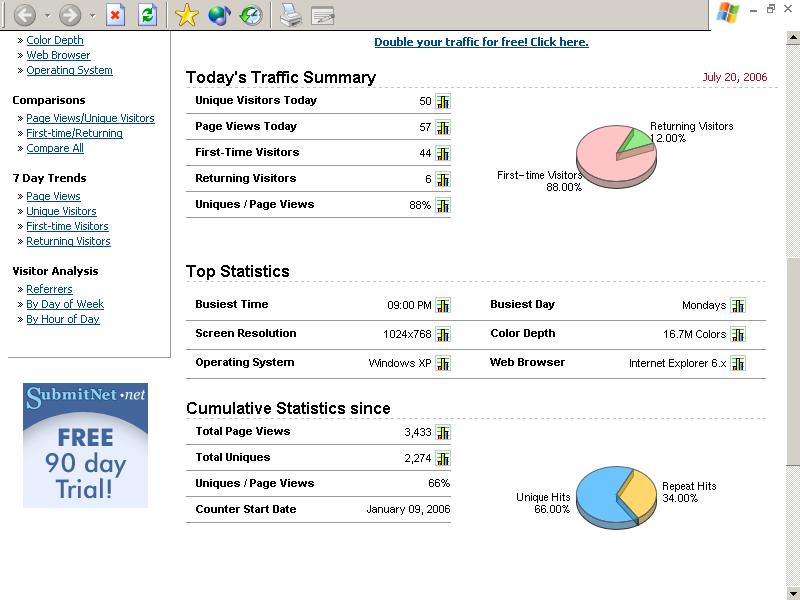
    With malice towards none: My repeat visitors in one day (i.e., today) is 12%; and since birth of this blog, repeat visits are 34% on the whole.

    Now, do you have any comments on the above two observations and this real-time picture of my blog's traffic, as seen below:


    See my previous posts:
  • Blog As A Teaching Tool
  • July 05, 2006

    Visualizing Comments on Blogs

    This is a running post: Updated 10 Feb, 2008:


  • Probing the Nature of Blog Communities
  • 5 ways to get more comments and make you smile February 24, 2006 @ Blog About Your Blog
  • Of comments and commentators @ Sayesha's world
    [see: The casual reader, The friend, The banterer, The loyalist, The silent reader, The 'almost there.' The judge, The mistake finder, The 'I've given up' blogger--Which one are you?]

  • Review: Naked Conversations, the stark naked truth about blogs, Information World Review
    A readable book that converts you to the power of blogging
  • Visualizing Web conversations using Talk Digger, by Frédérick Giasson, August 3rd, 2006
    In only 30 minutes of conversation browsing, I noticed 7 interesting use cases (patterns) in the system. I will present all of them by describing what is happening with each of them.

    coComment keeps track of all the online conversations you're following in one convenient place, and informs you whenever something is added to a conversation. [Thanks Sukhdev for this lead]

    Guardian has an interesting article on how the internet content generation has shifted from 80-20 principle (i.e. 80% of the internet content is generated by 20% of users) to 1-10-89 principle!
    i..e one user creates the content, 10 will "interact" with it (commenting/offering improvements) and the other 89 will just view it! Continue reading Thanks Ashish for this update!

    Here is a summary of how my concern to get a comment has been visualized by bloggers:
    1. Reciprocal Commenting is rare, but mandatory!
    2. You respond quickly and kindly to comments!
    3. ... when a complaint is made against blogging ... well then Hare Krishna! .. respond to it, and improve the situation for everyone...!
    4. One doesn't elicit blog comments by seeking them.

    And my 2 cent's worth responses:
    1. Thank you: I learnt what is mandatory, optional and click for 'next blog'.
    2. That is your speed to check your traffic. Godspeed you have, I mean.
    3. Hare Krishna... is this a Mantra for Bloggers to initiate communication
    4. I thought the basic lesson in life is seeking: Seek and You Shall Find; Ask and You Shall Receive. If you hadn't sent me an email on this wisdom, I couldn't have visualized your mind. Are you a Charismatic guru with 3D transparency (as an open source) to enable viewing mind waves!!!
    And don't have to say any more. The following comment about a comment says more than enough:

    Some people are like potatoes
    There are those who are content to watch while others work they are Spec Tators. Some never help, but are gifted at finding fault and tell others how to do it they are called Comment Tators. Source: www.enidnews.com, cited in

    Today's rant (a comment I just found):
    Interesting post, .... I had something interesting to say, but it took me so long to register for TypeKey I forgot what it was. {and now that blog post in only in google's Cache}

    From a Survey on blog comments:

    After reading the whole survey — or my selected excerpts — a question remains: are comments a good indicator of the success of a blog? As they remain invisible for the most part — you have to visit a blog and voluntarily click the “Comments” link of a post to read them — it seems that comments are only important to the blog owner and to the commentators themselves. Continue reading the survey @ Blogs for Companies, by Roland Piquepaille, April 10, 2006

    Why I don't get comments on my blog? Asked a friend of mine? His blog has a few multilingual and multi-disciplinary posts.

    I told him to read the following two comments from experienced bloggers:

    First, from Andrews's excellent post on infrastructure (including essence, nature, style, design, etc), presence or absence of comments. He has a detailed note on what makes presence of comments a value-added factor in blogs. I like the closing words in his post:
    May be you have a comment on Jacobs' comments about comments. If so, leave a comment in my comments, and I'll try to comment on your comments.
    Second, from G V Krishnan (a.k.a GVK), a well-wisher of mine, who responded to my complaint, among others, on two areas: a) why bloggers are so casual about commenting or responding to comments; and b) why no traffic at my blog. I really enjoyed reading his post. One needs time to read this eleven paragraph classic lesson in blogging .... [pl. ignore his golden rule, mentioned in this sermon: "A blog reader's attention span doesn't exceed three paragraphs."] Below is an extract from his post:
    Dr. Taher's latest lament is that no one takes note of his blog, self-billed as the world's first website to spread the 'multifaith' message. He had sent out a press announcement about his blog to some 300 plus print and online news sources, including western TV channels. None of them appeared interested in Dr. Taher's recipe for inter-faith tolerance, religious harmony and sustainable global peace...

    Dr Taher would have had better showing in the media, if only he had taken to blogging Britney Spears or the Brangelina baby birth in Namibia, Multi-faith wouldn't have a chance. What does Dr. Taher think he is? Dr Deepak Chopra? Or Pat Robertson? But then blogging empowers each one of us with a computer keyboard and Internet connection to reorder the world....

    To get noticed you need to blog something that interests other bloggers. Even something inane and mundane gets to be a hit at times. Blogger Glacier who commutes to San Francisco blogs his observations during his daily train trip in BART (Bay Area, Calif., rapid transit that covers four counties and carries 320,000 passengers) in Bartrage.com. It is accessed by over 25,000 readers a month...

    Dr Taher is a well-meaning guy with a mission. But then good intentions and lofty ideals count for nothing in the mad, mindless world of blogging. At a recent convention of bloggers held in casino capital Los Vegas they came to a consensus on ground rules for blogging. What is acceptable in blogging is polemics, provocative thoughts, bragging, and grandstanding. Plagiarism is okay. Haven't we heard pundits saying, blogging is like golf? You can cheat, but you need to be polite about it. Continue reading Dateline Mysore: Bloggers Don't Drip Like Leaky Tap by G V Krishnan
    These two citations apart, I continued my search for a better understanding if it is all ado about sense making or total nonsense. Luckily, I found two blog mindmaps. Both use creative visualization skills to show how Bloggers converse. The title of the first post is Weblog Conversations. This post is cited by at least three other blogs, but received a single comment. (Another blogger re-worded this title and called it, Visualizing Blog Conversation). The second minmap is a slightly different type, by Nakajima. Nevertheless, for all those who are interested in information visualization (including areas such as, data mining, conversation behavior and communication patterns) of blog comments the above two are excellent mindmaps. These two graphical images can be viewed in a comparative perspective at Data Mining Blog. No comments at this Data Mining post, please note.


    My research also found the following:
    One blog started a year ago, Comments Blog, and wanted to know expectations of bloggers who read his posts. This poor blog has received no comments, whatsoever.

    Some Other Comment Blogs:
  • Blog Comments Revisited
  • on blog comments
  • How to Pay for Blog Comments
  • Blog comments and SEO
  • Seth Godin on blog comments
  • Blogalysis=Blog+Analysis
  • State of the Blogosphere, April 2006 Part 2: On Language and Tagging
    Posted by Dave Sifry on May 01, 2006
  • More On Sense making
  • Some continue asking the same question: Why No Comments

    P.S. Whatever is the debate, libraries are now cataloging comments. One of these citations seems to be a good model, viz., Public Commenting on Organizational Blogs or Websites. Albeit, posted almost a month ago, it has no comments!!!
  • May 19, 2006

    Blog-to Show

    I found a very interesting blog. Anyways, are you ready for the Blog-to Show this weekend May 20-21 - [my shout] This is Last and Final Call!!!

    The details of the show are:

    We’re having a Blog-to Show Saturday and Sunday. Here’s what you do.

  • Write up a sentence or two about what makes your blog worth visiting.
  • Write up some advice or a short bloggy quote that you think other bloggers would like to know.
  • E-mail that information to Liz at lizsun2@gmail.com

  • All the best.
    For more visualization-cum-creativity visit Successful Outstanding Bloggers


    UPDATE, May 20, 2006:
    [P.S. Dear Visualizers, just-in-case you missed the bus, now read the following note posted at their door]:
    Link Leak Blog-to Show Is Open
    ME Strauss wrote this at 11:26 am:

    NOTE: We’ll do this again soon. So leave me comments on how we might do it differrently.
    If you’d like to be part of the next Link Leak Blog-to Show see the last box on this post.

    May 09, 2006

    Blog As A Teaching Tool

    This will be a running post: Updated 2 March 2007


    Blogging for Scholars
    Does your prof blog? If he or she does, you had better know about it. Professors who blog do so for a variety of reasons. Some are musing aloud over new ideas or research that will later appear in scholarly journals and on your library's shelves, virtual or physical. Some are exploring new ways of expression or appealing to a larger audience than they get in the paid lecture hall. Or they may be trying out a side of themselves that they don't quite dare expose fact-to-face with their primary community Continue reading @ Emerald LibraryLink

  • Moving Student Blogging Beyond the Classroom: Another Look, Posted by gsiemens, August 09, 2006
  • Emerging Teaching Tools. Distance Learning, Screen Recording, and Blogging, Ruth Duffy, July 24, 2006
    The theme of this conference -- Unfolding the Future -- is focused on ways to enhance tomorrow's college and workplace environment. In our workshop, we have highlighted three of the emerging technologies -- Blackboard, Camtasia, and Weblogs -- and how they are being used at Shoreline Community College. Now we would like to hear from you...
    If you are uncertain about how to do any of these steps, click here to go back and review. You may also listen by choosing "play this audio post" below. continue reading

  • Amanda @ blogwithoutalibrary.net, cites a new publication: "teaching social software," July 18, 2006, and Amanda states:
    Heads up: if you have any interest at all in teaching social software, you should read Teaching Social Software with Social Software by Ulises Mejias in the current issue of Innovate: Journal of Online Education (free registration required for full-text)...
    As you can imagine, I was thrilled to stumble upon this article (thanks, Paul!), given the fact that I’ll be doing a bit of teaching-social-software-with-social-software myself this Fall. I was even more thrilled to find out that Innovate hosts webcasts with their authors, and Mejias’ webcast happens to be this Thursday at 12pm.

    A Biological Blogger, July 14th, 2006
    Paul Z. Myers, an associate professor of science and math at the University of Minnesota at Morris, is something of an accidental blogger: He only started after setting up a Web site for students enrolled in one of his courses...

    How does a blog on developmental biology become such a big hit? Injecting a bit of politics into the proceedings doesn’t hurt: Mr. Myers, who bills himself on the blog as a “godless liberal,” mixes strongly worded attacks on creationism and intelligent design in with other “random biological ejaculations.” —Brock Read . Continue reading from A Biological Blogger. More of this Genre Webblogged at Blog Juice for Educational Technology

    Not sure, what is this all about?
    Hearing, seeing and listening may change your perception.
    Here you go [just-in-case you want to be oriented towards this subject] with a :

    TITLE: How and In Which Situations Web Logs or Blogs Work: How and Why They are Valuable in Children's Education
    SPEAKER: David Weinberger
    EVENT DATE: 11/15/2004
    RUNNING TIME: 55 minutes. (Thanks to Web Capture @ Library of Congress for sharing this excellent speech)

    I guess I am the ten zillionth person who is trying to visualize the above question. The deep web has this question and stated in umpteen ways. Nevertheless, the most common concerns include, viz.: a) the suitability of this tool to communicate; b) the compatibility of this tool in interactive learning process; and c) find WHAT WORKS, WHAT DOESN'T, WHAT'S PROMISING

    Let us begin with a reflection on the process involved and visualize the whole picture:


    "...These days it is rare to talk about a single function tool. Many discussion board providers now bill themselves as community software providers and bundle other tools into their products such as chat, instant messaging, polls, blogs, wikis, member directories and file sharing. So you will find some overlap between the first few sections of the tour and the groupware section! In addition, there is sometimes a split in communities where some like blogs and wikis and others prefer discussion boards. This split may be generational, but regardless of its origin, it is helpful to be aware of this and figure out how to bridge between the groups when picking tools."[source: Web Based Discussion Tools, in Tool Tour, by Nancy White. See also herein excellent illustrations and examples in "Social Software Tools (Blogs, Wiki's, and Other Creatures)."


    I will summarize my findings. The Webliography at the end of this article will give a link to some significant resources.

    A. Blogsavvy's prescription very valuable (value added because, it has received 53 comments, which would mean some thing that is really worth looking at!)

    How NOT to use blogs in education:
  • Never never approach blogs as discussion boards, listservs or learning management systems
  • Group blogs are a bad idea and don’t work
  • Don’t try and force blogging into something else
  • Ignore RSS at your peril

  • B. Arguments for and against using Blog are equally educating, in the Blog by Anthony Moretti, and I quote:
    Arguments for using Blog as a Tool:
  • Young people are using this technology; they might not read as much as we would like them to, but they do blog (and love pods)!!
  • Can foster creativity and expression; if this gets students to write, think, analyze; why not use it?
  • Cheap; can be set up for no money and be used in a variety of ways
  • Errors, omissions, biases, etc. can be caught
    Arguments against using Blog as a Tool:
  • Small audiences
  • Staying power?
  • Deciphering the junk from the credible

  • C. Despite the above inspiration, the Sixty Four Dollar question remains:
  • Are blogs good for education? Bill Bruck wrote in his blog as early as in December 2004 in Blended Learning:
    Well, they aren't awful. They are fashionable right now, and so may gain learner acceptance. They get learners to write, which is inherently good, and to express their opinions - which may or may not be a good thing. But there's a fundamental problem with blogs: They are essentially optimized for easily publishing one’s opinions on the web. This is fundamentally a flawed model for education. It promotes narcissism, not dialog.

    D. And the wise continue the debate. The latest evidence-based wisdom comes in a podcast, "Blogs in education: podcast," delivered by Keith Burnett’s blog, and posted on April 2nd, 2006
    Educational uses of blogs include: as class diary for a specific group of students, as notice-board for a whole cohort, and even as a space for students to write themselves.
    Students producing their own blogs requires careful thought. Web pages are cached by search engines and can be held in ‘frozen’ form for years – for this reason students might want to post under an assumed name. You also need to check College regulations about external publication by students. Some students find having their own page to show off work a motivational factor. Some teachers use blogs as notice boards for whole cohorts of students. I would suggest switching off the commenting in this case and possibly adding an e-mail list facility so students can have new notices e-mailed to their inbox.
    I find that I have most success with blogs used as class diaries – each class has a page. I can pop a summary of each lesson on the blog, and I can add links to Web pages with exercises, explanations, interactive quizzes or demonstrations. The blog can then be used by students who were at the lesson as a reminder of the main themes (and homework) and as a guide to carefully chosen and relevant Web pages. Students who had to miss all or part of the lesson can find a summary, possibly with text-book readings and some links that will enable the student to get the gist of the lesson and be able to join in a little more next week.

    E. Research Prospects in this Area
  • Blogs help students think for themselves,by Anna Salleh, ABC Science Online, 2 September 2005:
    Blogging is helping students to think and write more critically, says an Australian researcher, and can help draw out people who would otherwise not engage in debate.
    These are the preliminary findings of PhD research by Anne Bartlett-Bragg, a lecturer at the University of Technology, Sydney, who has been using weblogs or blogs in her own teaching since 2001.
    She says blogs are also extremely useful for categorising and managing a large collection of thoughts, whether they are from lecture notes, a student's own ideas, or comments on the ideas of others.

    F. Webliography:
  • Susan Crawford. Blogging on blogging on blogging, 02 Jun 2006
  • Zarah Grace C. Gagatiga. Blogs as Teaching Tools, 1 May 2006 
  • --. Blogging as a Tool for Teaching, March 29, 2006
  • Anthony Moretti. Using Blogs as a Teaching Device, 2 May 2006
  • Minjuan Wang, and Laura Bock, The Use of Blogs in Teaching, Knowledge Management, and Performance Improvement, World Conference on E-Learning in Corporate, Government, Healthcare, and Higher Education (ELEARN) 2005
    Vancouver, Canada October 24, 2005, ELEARN, Volume 2005, Issue 1.
  • Craig W. Smith. Synchronous Discussion in Online Courses: A Pedagogical Strategy for Taming the Chat Beast
  • Teacher dude. blogging and teaching ESF/EF, 3 May 2006
  • GIL KLEIN. iPods, podcasts latest teaching tool in classrooms, May 1, 2006
  • Ben Yates. Wikipedia as a teaching tool, 19 Jul 2005 
  • Learning from blogs, by Anna Davis, at EduBlog Insight [EduBlog is a place to reflect, discuss, and explore possibilities for the use of weblogs in education]
  • A. S. Tolba. The Potential of Blog as a Teaching and Learning Tool, 4 Nov 2005
  • Bryan [ http://killthefattedcalf.blogspot.com/2006/02/academic-blogs.html dead link ], Academic Blogs
  • Ewan McIntosh.Assessment is for Learning - so is blogging
  • What are the pitfalls of using blog as a teaching environment?
  • See also Blogsphere Search results 1 and Blogsphere Search results 2
  • Natasha Spring and William Briggs, Ed.D.The Impact of Blogging: Real or Imagined? [text in pdf]
    Microsoft's technical evangelist Robert Scoble met recently with CW Executive Editor Natasha Spring and frequent CW contributor William Briggs to set the record straight on blogs, their impact on the media, whether companies have anything to fear from this new communication medium, and the release of his new book, Naked Conversations.
  • Dorai’s LearnLog. Effective Bloggers are Learners, Thinkers, Explorers and Dreamers, May 26, 2006
  • Nancy White. Seven Competencies of Online Interaction,from the Northern Voice 2006 Canadian Blogger Conference in Vancouver on 11 February 2006
  • Diane Levin ,Mapping the blogosphere yields information about human behavior for social scientists, June 27, 2006
  • Track A — Blogs, Wikis, and Collaboration Tools, Internet Librarian International 2005, Transcending Boundaries: Information Technologies & Strategies for the 21st Century, 10-11 October 2005 • Copthorne Tara Hotel, London
  • Improving the quality of online presence through interactivity, Information and Management archive, Volume 42 , Issue 1 (December 2004), 217 - 226: 2004
    Online interactivity is becoming a valuable way of improving the communication quality of business web sites. As a result, it is important that web site designers understand the concept and how it affects the quality of web site design. This study empirically validated Ha and James' five interactivity dimensions (playfulness, connectedness, reciprocal communication, information collection, and choice) and their relationship to design quality. Continue Reading Improving the quality
  • Goodbye, Blog: The friend of information but the enemy of thought, by Alan Jacobs
    Whatever one thinks about the structure of the internet as a whole, it is becoming increasingly clear that the particular architecture of the blogosphere is the chief impediment to its becoming a place where new ideas can be deployed, tested, and developed. Take, for instance, the problem of comments. Continue reading Goodbye
  • TLT Group. Exploration Guide: Educational Uses of Blogs, Wikis, RSS Feeds, etc.
  • Using technology in teaching and learning cited by Cindee. [Full citation ]
    Using technology in teaching and learning: Resources to help you navigate a digital world, C&RL News, February 2007, Vol. 68, No. 2, by Bryan Alexander
  • Accuracy and the Blogosphere
  • Wikis, blogs and podcasts: a new generation of Web-based tools for virtual collaborative clinical practice and education, by Maged N Kamel Boulos, Inocencio Maramba, and Steve Wheeler, BMC Med Educ. 2006; 6: 41.
    Published online 2006 August 15. doi: 10.1186/1472-6920-6-41. [full text]


    See also my previous posts:
  • Citing a Blog, Wiki - Style for bibliographic notes and references
  • What's a blog - WYSIWYG
  • Blogging Spree: Trends in Information Visualization
  • Information Visualization at Wikipedia - Blogspheres Perspectives

    Quotable quote from Library Stuff:
    The power, posted December 19, 2003
    Anna writes:
    "There's something seriously wrong with the world when one innovative, blogging, rarin' librarian can have more links in a web directory than one of the most important theorists on classification and indexing."

    That's the power of weblogs, especially in the library world. I'm not sure why this is surprising, however. Who is more likely to have more content on the web, Jessamyn or Ranganathan? You will probably find more information on Ranganathan in books (library science 101, etc), than Jessamyn. Also, as Greg so dutifully points out, most of the links are interviews. When was the last interview you read on Ranganathan?
  • February 26, 2006

    Blogging Spree: Trends in Information Visualization

    In how many ways are blogs analyzed? Answer to this is very hard to find.

    In the following are few samples that facilitate understanding trends in blogging[i.e., how blogging is gaining acceptance, addiction, attention, etc.]
    1. Linkology, By Stuart Luman

    There are upwards of 27 million blogs in the world. To discover how they relate to one another, we’ve taken the most-linked-to 50 and mapped their connections. Each arrow represents a hypertext link that was made sometime in the past 90 days. Think of those links as votes in an endless global popularity poll. Many blogs vote for each other: “blogrolling.” Some top-50 sites don’t have any links from the others shown here, usually because they are big in Japan, China, or Europe—regions still new to the phenomenon.
    2. Data Mining - A World United by Cartoons:

    Here's what DataSphere looks like highlighting the locations which have news articles about (islamic) cartoons [around 10pm on the 15th of Feb]

    3. The Virtual Handshake Blog 2/13/2006, Haves and the Have-Nots of the blogosphere,
    Posted in Social Network Research, Blogging
    by David Teten @ 10:19 am —
    4. A Model for Weblog Research
    Given that weblogs are now becoming an object of research for social and computer scientists alike, it is perhaps an idea to look for a model (I hate the word).
    One model element some think is important is size. The Weblogging Ecosystem workshop (Edinburgh 2006) is running a data challenge:
    Much of the interest in research relating to weblogs involves the analysis of large quantities of data. As part of this workshop, we are very excited to provide a data set to the research community. The aim is to encourage the use of this data to focus the various views and analyses of the blogosphere over a common space...

    See also:
    ~~~~metamanda>>weblog information visualization Archives

    ~~~~Top 50 blogs ranked by Time Magazine in 2005.

    ~~~~Dissecting Technorati Top 100 and Blog Ranking Algorithms (Promotion)

    ~~~~Feedster Top 500 - Search Engine Blogs

    ~~~~[pdf]A study of Blog Search, Gilad Mishne Maarten de Rijke 28th European Conference on Information Retrieval (ECIR'06) 2006