About this Blogsphere:

This blogsphere attempts to capture, catalog and share resources relating to visual perception of information. It is about a world mostly dealing with Physical (Touch, Taste, See/Sight, Smell and Hear) and sometimes Metaphysical (and that is none-of-the-above category). Physical, for instance, touch (e.g., feel, felt, found), look and visualization, is here with an attempt to combine verbal, vocal and visual--to synchronously see, hear, share and do much more. Interestingly, in order to visualize one does not need special skills, competencies, etc. It is all about common sense, especially with human visualizations. In short, "information is in the eye of the beholder." Continue reading much more all-ado-about this Blogosphere

Akbani is a Cutchi Memon family name.

Showing posts with label Reading. Show all posts

June 08, 2014

A Creative Visual Formula to Know Readability in 'My Library' @ CARTOONS BY TOM GAULD

1770461043 You're All Just Jealous of My Jetpack: Cartoons
By Tom Gauld -- Tom Gauld lives in London. His comics frequently appear in The Guardian, The New York Times, and The Believer. He has designed a number of book covers. 

Which color dominates in your library? (cartoon)


My book of cartoons ‘You’re All Just Jealous of my Jetpack’ is available now:US: http://www.amazon.com/dp/1770461043UK: http://www.amazon.co.uk/dp/1770461043Other stockists and info at www.tomgauld.com
what’s the difference between “intending to read” and “saving for when I have more time”? or between “pretend I’ve read” and “purely for show”  Source:  book of cartoons ‘You’re All Just Jealous of my Jetpack  
Review: ""Tom Gauld is pretty brilliant. You’re All Just Jealous of My Jetpack.. is ... dark and funny. Some of the best comics in the collection are the bookish ones, taking chummy digs at everyone from Martin Amis to the Brontës to “proper literature.” —Flavorwire 
-- (see also notes)
On the same shelf:
  •  What kind of library user are you (Quiz)?  Are you a “Library Lover”? An “Information Omnivore”? Or are you totally “Off the Grid”? Take our library engagement quiz to learn how your library habits and attitudes stack up against the general population.
  • BOOKS BEAT SUMMER SLIDECheck out our latest infographic to see just how much kids' reading skills improve when they have access to books over the summer.Photo: BOOKS BEAT SUMMER SLIDE! 

Check out our latest infographic to see just how much kids' reading skills improve when they have access to books over the summer.

http://blog.firstbook.org/2014/06/03/books-beat-summer-slide/

March 01, 2014

365 Days HolyBook Reading Charts

Christianity: 
Additional resources @ Amazon.com

Islam:
 Additional resources @ Amazon.com
Judiasm:
Additional resources @ Amazon.com

Hinduism
Additional resources @ Amazon.com
Sikhism:
 Buddhism:
 Additional resources @ Amazon.com
Bahai:
On the same shelf:

April 29, 2011

Designing human-awareness for ambient agents: A human mindreading perspective

Research about human senses and human needs, in relation to information seeking behavior, information access mechanisms and information retrieval techniques continue and here are some interesting information visualization attempts, all probably contributing in some way to the understanding of the Semantic Web:

A study, by Dr. Zulfiqar A. Memon, Journal of Ambient Intelligence and Smart Environments, [also here]
ABSTRACT: Ambient Intelligence (AmI) [1] has the vision to make Information and Communication Technologies disappear into the environment thus creating an ergonomic space for the inhabitant, encompassing an active living environment around us. To bring this goal to realization, devices need to be built possessing knowledge about humans enabling these devices to show a more human-like understanding. For this, we need assistance of human-directed disciplines such as cognitive science, psychology and biomedical sciences that develop models for many different aspects of human functioning. By representing these models in a formal and computational format, and incorporating them in these devices, these devices can be made more sensitive and responsive to humans [3]. The integration of these models within AmI applications is becoming more widely known as human-aware ambient agent modelling. Theory of Mind (ToM), or mindreading, is an ability to attribute mental states such as, beliefs, intentions, desires, pretending, knowledge, emotion etc, to others and to understand that those states may be similar or different from one's own. The work presented in this thesis makes contributions in the area of modelling and simulation by analysing and designing ambient agent models integrating concepts of Theory of Mind, to make these models human-aware. To explore the applicability of the approach proposed in this thesis, it has been applied in different specializations addressing integrated approaches to, for example, emotion generation and reading, emotion contagion, believing, desiring, feeling, decision making, and attention [2].

On the same shelf:
  • Edgar Meij's PhD Thesis: Combining Concepts and Language Models for Information Access
  • Knowledge Representation and Reasoning (Computer Science)
  • [Comp-neuro] Summer School on "Beliefs and Decisions: of Minds and Machines" The neuroinformatics site
  • UNDERSTANDING AND SUPPORTING INFORMATION SEEKING TASKS ACROSS MULTIPLE SOURCES by Dr. Alia Amin
    Extract:
    "We focus on investigating how visualization influences lay users' confidence while accessing information from different cultural heritage information sources"
  • April 16, 2007

    Add Sense to your AdSense: Visualizing the Return on Investment?

    This post is regularly updated. Last update May 5, 2007


    Thought for the day on Return on Investment (ROI):
    If only things could talk, they could tell us who made them and where they'd been. If they were lost, they could shout, "Here I am!" If they were damaged, mistreated, neglected or expired, they could tell us that, too. They could tell us how to use them, repair them and dispose of them safely. Are you reading me? KEN HUNT, Globe and Mail, 11/04/07

    Visualization is creating a mental picture of something in your mind's eye. Visualization techniques are important because they help make the future become more clear. Seeing yourself already achieving your goals makes your brain believe that attaining that goal is possible. Focusing consistently on any given goal will enable you to manifest it far sooner than if you do not focus on it at all; focusing brings the goal closer to you. Tips For Mastering Visualization Techniques, By Scott White Published 03/22/2007


    See also:

  • google adsense sparklines,
  • Jenett, Marilyn. "Are You Visualizing "Out There" Or From Within?." EzineArticles 10 November 2004. 15 April 2007
  • Inserting adsense code in Postnuke article by nmjudy
  • Adsense And The Surfer, Ryan Smith Published 03/22/2007
  • Sense and Nonsense About Adsense, By Alex Newell Published 03/22/2007
  • Google AdWords plus Google Analytics: Market Manipulation and Possibility of Mischief? by Avinash Kaushik
  • Google and Behavioral Targeting Part III – Google Buys Doubleclick, Anil Batra
  • March 23, 2007

    Look and Feel of Browsers and Websites

    Browsers, Web sites' (including content, design and visualization) have sites, sights and insights, courtesy: It is a numeric life Blog


    Well designed web pages
    An recent experiment demonstrated that tighter writing, more white space, and jettisoning unnecessary imagery helps readers read 50% faster and retain 34% more of what they've read. That explains why most people love Google's home page. Continue reading more: Eyetracking points the way to effective news article design, By Laura Ruel and Nora Paul

    My previous related posts:
  • A visual Newsmap
  • Visual Search Plus
  • Visualizing the Web Infostructure I - Cites, Insights, Farsights
  • February 03, 2007

    Sight, Sound, Senses Visualized - Creative Innovations in Touch and Tell Spheres

    [NB. Rest in the Waiting: smell, taste, touch]
  • Web site helps name that tune in your head [Sify.com]
    Singapore: You know that annoying tune that you can't place or get out of your head? A US company has recently launched a Web site, www.midomi.com, that names most tunes that you can hum, sing or whistle a tune into your computer microphone. [Image source and more details: Website Lets Users Search For Unknown Tunes That Get Stuck In Their Head, Thursday February 1, 2007]

  • Librarians will see Margaret Atwood's Long Pen for the first time at the Ontario Library Association Super Conference's THE 2007 EXPOSITION, Feb 1 -2, 2007

  • Margaret Atwood's telepresence book-signing robot Clive Thompson, March 01, 2006
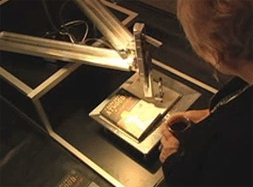
    Wow: Margaret Atwood has become the first author to sign books in remote locations -- via a telepresence robot!


    Last fall, she hooked up with a Toronto company called Unotchit (which sounds roughly like "you no touch it") that developed a device that works like this: Unotchit sets up its robot in a remote bookstore. Atwood logs in from home, and using a webcam, talks to people who are attending the far-off book-signing. She chats with 'em, asks what they want inscribed on their book, and they lay it in front of the Unotchit robot. Atwood writes on a screen, and the robot replicates her pen-strokes precisely, in real-time, on the book.

    Previous posts in the same row and isle:
  • Guided Imagery / Visualization - Uses with the Cancer Patron
  • Infomedia Revolution Revisited
  • Visual Communication Vistas Revisited
  • Scientists and Artists: Who should design learning?
  • The Technique of Song and Sound Visualization
  • January 08, 2007

    Graphic novels being challenged by parents

    Posted by the Asbury Park Press on 12/21/06
    BY DAVID TWIDDY
    THE CIATED PRESS

    KANSAS CITY, Mo. — When Amy Crump took over as director of the Marshall Public Library in central Missouri two years ago, she decided to build up the library's offerings for young adults by buying the literary world's hot new thing …graphic novels.

    "The bulk of our graphic novels are for young adults and they're very popular,'' Crump said, estimating the library's collection has gone from only a handful to around 75.

    Among the new acquisitions was "Blankets'' by Craig Thompson and "Fun Home: A Family Tragicomic'' by Alison Bechdel, two semi-autobiographical accounts of the respective authors' turbulent childhoods that include ruminations on strict
    religious upbringing and homosexuality.

    The two novels touched off what Crump said was the first challenge of library materials in Marshall's 16-year history, as parents complained that the books, which include pictures of a naked couple, could be read by children, attracted by the comic book-like drawings. Continue reading the full story


    Previous post:
  • Scientists study Christie success - Quantification to see true color of words
  • July 28, 2006

    Get a free book - Courtesy: [Geeks are Sexy] technology news

    Wish to get a free book? Read the following -- (incidentally, this Geeky blog is among the top ten Blogs Of Note, today Aug 1st 2006):


    Contest: Get a FREE book from [GAS]

    A few days ago, newfound buddy Chip from Chip’s Quips decided to run a "get a free book" contest on his blog. He asked people to give him a few reading suggestions, and the person who suggested the book he would pick as his next read would end up winning the contest. The Prize? One book of a value of less than $20.

    I thought that this was a great idea, so I'm going to run the exact same contest. Click here to join the contest

    May 17, 2006

    Every Book Its Reader - Ranganathan's Law Visualized

    Here is a book. It borrows its title from Dr. S R Ranganathan's third (of the Five) Laws of Library Science. The details of the book are:
    Nicholas Basbanes. Every Book Its Reader: The Power of the Printed Word to Stir the World (HarperCollins, 2005). Reviews
    What makes the book interesting for me as a librarian and a student of history?
    Simply stated, it is my curiosity to find out how relevant is my Guru's Five Laws of Library Science and how his mantra is still floating in a world that is now flat (as per the history of the world by Thomas Friedman).
    OK. What are these Five Laws? To read click here
    Going by the title one may ask:

    • Is this book about outsourcing?
    • Is this book about extranets
    • Is this book about offshoring
    • Is this book about open-sourcing?
    • Is this book about In-forming

    Incidentally, such questions are bound to be asked, if one has just finished reading, India versus Indiana: Who is Exploiting Whom? - a chapter from The World Is Flat: A Brief History of the Twenty-first Century by Thomas L. Friedman, Farrar, Straus and Giroux, 2005. see my comments on Friedman's book
    A single answer to the above questions would be, simply said, the book has none of the above.
    A last question one may have, because as a student of Library Science, I succinctly recall that there is one significnat implication of this third law. This implication is all-a-do-about OUTREACH. That is, reach everyone of those who cannot reach the library.
    Then, does this book deal with libary services and innovations in outreach and reaching out?
    The answer, again, is in negative.
    WHEREAS, the book is about how the printed word--or how the love of books--makes history (i.e.,Yesterday, Today, and Tomorrow of the printed books). As a student of library history, I see this book is of great value for the posterity.
    On the Law, per se, I have a word to mention.
    The author writes an interesting note about Ranganathan and his Five Laws:
    In time he wrote fifty monographs in his field, most notably Five Laws of Library Science (1931), which outlined a set of principles that ha become a guiding code among professinals.

    Three of these laws--Books Are For Use, A Reader's Time is Precious, and Libraries are Growing Organisms--were directed primarily at his colleagues. The other two--Every Reader His Book and Every Book Its Reader---have meaning for anyone with an abiding respect for the written word. They also form the guiding premise, and suggested the title, for this book.(p. 15-16)

    Furthermore, regarding the appropriateness of the Third Law for this type of library history (meta book, book about books, and bibliomania), I had my own doubts. And this doubt is clarified, to me, by a close assoicate of Dr. Ranganathan, viz., Prof. A Neelameghan, in the following words:
    In general, the set of Five Laws constitute the guiding principles / the fundamentals of library and information service in the changing info environment. LIS professionals would do well to provide service that complies with these laws.
    End-users (readers) may also use the first three laws to ‘evaluate’ the service they are getting from the library, again in the changing info environment. (personal communication, dated May 16, 2006)

    ‘Every Reader His/Her Book’ can, as I mentioned earlier, viewed from the library professionals point of view and also that of the ‘Reader’. A reader may search first an online catalogue / union catalogue (in a library or from home), then (or straight away) go to the library for his book, or to a book shop, and to a friend’s book collection, etc. depending on when his need gets satisfied. When he visits the library the latter is expected to have organized the collection, etc and provide services that ensure the reader gets his book from its own collection, or through inter-library loan, or reader given advice where and how else he / she may get his / her need satisfied; sometime it may be another book that satisfies his / her need better than the one he / she may be looking for. The interpretation of the Laws can comprehend different viewpoints. (further clarified in a second personal communication, dated 17 May 2006).

    The Bottom Line: Thank you Nick (ie., Prof. Nicholas Basbanes) for this learning opportunity. And Wish You Good Luck to Write More Books. But, do not forget the mantra. I mean, remember there are four more LAWS of my Guru. I wish and pray that God give you a long life to write at least four more books.

    February 16, 2006

    Books and senses - visualization conceptualized again

    [The following article is an excellent voice and simply promotes the conceptual framework of my blogsphere. Thank you Jacek]

    Books and senses by Jacek Czarnik
    Some time ago, I was glancing through the manuscripts written by Ignacy Krasicki. They contained fragments of poems, first drafts of fairy tales, and other notes. I new most of them, therefore I concentrated on the quality of handwriting of this ancient poet. It was an experience, interesting, even emotional. However, the strongest experience came from the touch. I could grasp with my fingers the same pages that he touched. Only this surrogate contact - in spite of two hundred years separating us - evoked in me an emotional shudder.

    Touch is a sense of fulfilment, without it, belief is difficult, love is handicapped, and knowledge is incomplete. Books have to be touched. They are meant for the hand as well as eyes and mind. Complete contact with them occurs only when one feels their weight, smoothness or roughness of the binding, elasticity or softness of paper. It is difficult to content oneself with just looking at them through the window of a bookshop or contemplate, enclosed in a bookcase, however masterfully conceived, title printed on the back of a book.

    There are not many forms of art in which an artist can consider the effect of his creation on the sense of touch. Writers are fortunate to have at their disposal many possibilities. A book stimulates almost all senses. The eye can behold the beauty of illustrations and decorations. The nose is enticed by the aroma of printers ink. The rustle of foil covering graphic reproductions intrigues the ear, and the whisper of turning pages calms the mind. The experiences connected with taste can, in truth, be only accessed through one's imagination, stimulated by the content of the book. At times, the world conjured by text replaces reality. The forces of imagination cannot be underestimated.

    The foremost impression associated with a book is visual. Multiplicity of elements forming the material entity of written and graphic media enforces the necessity of creating a unique "architecture" of printed text format and book, as a whole. This task demands a degree of talent, taste, courage, and thorough specialist knowledge.

    Keep reading

    Source: Contemporary book art - EBIB No.10/2002

    January 06, 2006

    Scientists study Christie success - Quantification to see true color of words

    A bibliometric (quantitative) law, called as Zipf's law, deals with frequency of word occurrence:
    Originally the term Zipf's law meant the observation of Harvard linguist George Kingsley Zipf (SAMPA: [zIf]) that the frequency of use of the nth-most-frequently-used word in any natural language is approximately inversely proportional to n

    Interestingly, some who study 'word frequency' may know or may not know about the existence of Zipf's Law. And BBC NEWS feature (18 December 2005) as shown below, does not mention about any such statistical worldview:
    Novelist Agatha Christie used words that invoked a chemical response in readers and made her books "literally unputdownable", scientists have said.
    A neurolinguistic study of more than 80 of her novels concluded that her phrases triggered a pleasure response.
    "Christie's language patterns stimulate higher than usual activity in the brain," Dr Roland Kapferer said.

    ... The Agatha Project study was carried out by scientists from universities in London, Birmingham and Warwick for an ITV1 documentary.
    It involved loading Christie's novels onto a computer and analysing her words, sentences and phrases.
    It aimed to explain the enduring popularity of the work of the late author, who created detectives Miss Marple and Hercule Poirot and wrote novels such as Murder on the Orient Express.

    ...Christie was also found to have used a very limited vocabulary.
    "It means that readers aren't distracted and so they concentrate more on the clues and the plots," said Dr Pernilla Danielsson of Birmingham University.
    They also found that Christie frequently used dashes to create "a faster-paced, unreflective narrative".
    Read more

    Thanks to the blog by Brenda Schmidt, and her description which brought me to this news item: "If only I could figure out how to release"

    ~~~~See also: Studying Cooperation and Conflict between Authors with history flow Visualizations, by Fernanda B. Viégas, Martin Wattenberg and Kushal Dave;
    MIT Media Lab, Cambridge, MA 02139 USA,
    P.S. You are not sure about this subject of visualizing frequency of word?
    Click here to see a visual: word popularity colorizer.

    January 04, 2006

    Lulu Book Title Analyzer - Another perspective for the visualizers

    The Lulu TitleScorer has been developed exclusively for Lulu by statisticians who studied the titles of 50 years’ worth of top bestsellers and identified which title attributes separated the bestsellers from the rest.

        Given below is the extract of a news story in National Post, Dec 16, 2005, appeared with a headline: Yes, You Can Judge a Book by its Title -- Program 70% Accurate," by Misty Harris. Also, published as "Anyone who says you can't judge a book by its cover isn't trying hard enough" in Windsor Star:
    A British statistician has developed a complex computer model able to calculate a book's likelihood of being a bestseller based solely on its title.
    In a study released Thursday, Atai Winkler reports his new program is able to accurately forecast the strength of a book's sales nearly 70 per cent of the time -- about 40 per cent better than random guesswork.
    After analysing 11 variables, from the number of words in the title to the entomology of the words used, three key "differentiators" were found between bestsellers and non-bestsellers.
    "It usually becomes a gut-instinct kind of thing where the title rolls off the tongue well or sounds good to the ear," says Sellers. "I'd say that's as scientific as it gets."

    Related research on this area includes:
    ..Language Log: Judging a Book by Its Cover
    ..More at Google
    ..SEE ALSO Quantification Titles @ Amazon from my Listmania (Informetrics, quantitative, bibliometric, webometric, etc.)
    -----
    About Misty Harris
    Additional Reference:
    Zipf, Power-law, Pareto - a ranking tutorial, by Lada A. Adamic
    Many man made and naturally occurring phenomena, including city sizes, incomes, word frequencies, and earthquake magnitudes, are distributed according to a power-law distribution. A power-law implies that small occurrences are extremely common, whereas large instances are extremely rare. This regularity or 'law' is sometimes also referred to as Zipf and sometimes Pareto. continued ...

    More about Zipf's law